Somewhere right now, a ride-hailing founder is sitting in front of a laptop with three browser tabs open. They've outgrown WhatsApp dispatch and need a taxi booking app, fast.
Tab one: an agency quote for $280,000.
Tab two: a SaaS platform offering "everything you need" for $30 per driver/month.
Tab three: a Reddit thread where someone built the whole thing for $40K.
So which number is real? All of them are. They're simply measuring different things.
The $280K likely includes custom dispatch logic, infrastructure, integrations, scalability, and long-term ownership. The $30 is an entry SaaS price tied to a specific number of drivers, rides, integrations, and platform limits. The $40K is whatever the person in the Reddit thread needed, which probably wasn't what you need.
How do you compare them? You don’t. But you can understand what each model costs at your fleet size, three to five years from now. We're a transportation software development company with long enough experience to know what happens when a growing fleet outgrows a SaaS platform mid-contract. This article is built on that experience.
TL;DR
- Taxi booking app development cost varies because they're not pricing the same things. To make a sound decision, you need to understand what each option costs at your fleet size in the long-term perspective.
- A taxi booking app is more than passenger and driver screens. Dispatch logic, real-time infrastructure, integrations, AI features, and dynamic pricing drive most of the cost.
- SaaS platforms look affordable early, but costs scale together with your fleet, ride volume, integrations, and operational complexity.
- SaaS costs are not only per driver or support fees. It often includes per-ride fees, onboarding, dispatch integrations, missing-feature workarounds, and vendor roadmap dependency.
- Custom development costs more upfront, but becomes financially predictable as the business grows because you own the infrastructure.
Whatever path you choose, calculate the full three-to-five-year cost for your specific fleet first.
What's in a taxi booking app development cost and why it goes up
Before any taxi mobile app development cost comparison makes sense, you need to understand what you're buying. A "taxi booking app" is a system of interconnected layers, and every one of them is a decision point that affects cost.
Let’s start with the visible layer that includes a passenger app, a driver app, and a dispatcher panel. These are the components most people picture first. Passengers book rides, drivers accept trips, and dispatchers monitor the fleet in real time.
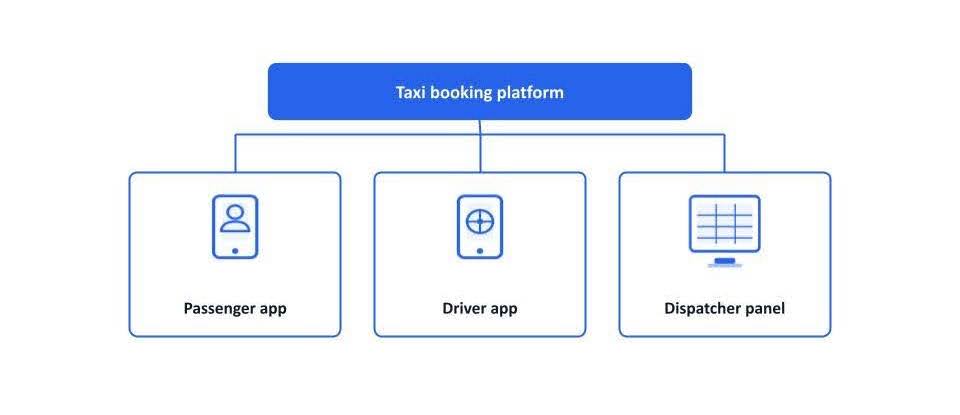
But the apps are only the tip of the iceberg. Behind the screens sits the infrastructure that keeps the whole operation alive.
Real-time tracking requires a persistent connection architecture such as WebSockets or similar. Underbuilt, and everything breaks during peak traffic. Then comes payment infrastructure. The platform needs to connect to payment gateways, process refunds, secure customer payment data, and comply with PCI DSS requirements for card transactions.
Want dynamic pricing? Then the system has to analyze demand, driver availability, ride density, and geographic zones fast enough to adjust prices in real time.
Then comes fleet ERP integration. It is one of the most painful points and a major cost driver. Every integration adds development time, testing overhead, and future maintenance requirements.
And we can keep going with SMS infrastructure, audit logs, demand forecasting, and so on. All these add to the final cost.
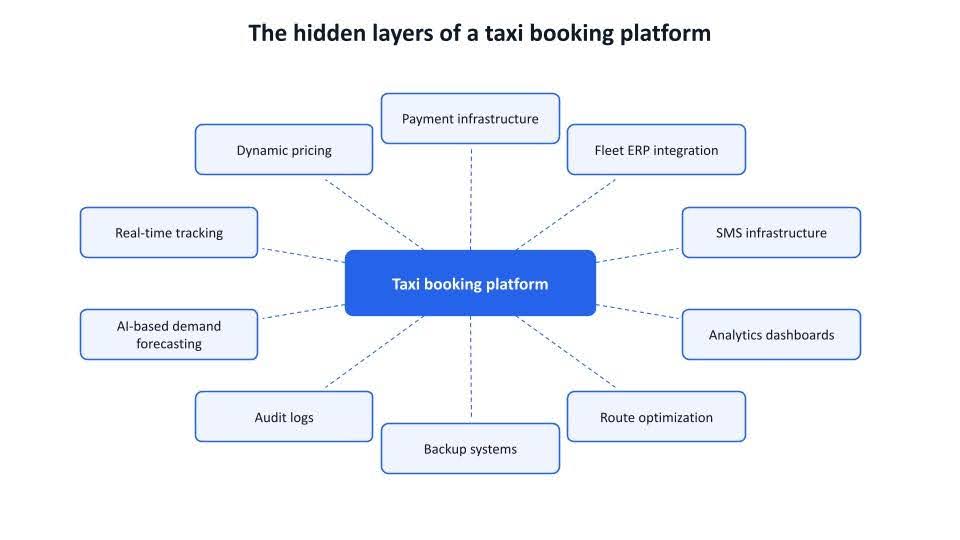
Generalist agencies often quote only the visible parts of the product and leave the harder infrastructure for later. That’s why taxi app pricing can vary so much from one vendor to another. Not to mention SaaS, where you see a ridiculously low price for a month.
Looking for an Uber-like app, custom-built, not cloned?
Share your idea with us, and we’ll map out the operational system behind it.
Alina
Client Manager

To unpack those price tags, we need to look at what sits underneath them.
The honest taxi app development cost comparison for 2026 (including cost ranges)
In simple terms, there are two main paths for building a taxi booking app: using a SaaS platform or building a custom solution. Let’s start with SaaS and look at a few platforms with publicly available pricing.
Path 1. SaaS taxi booking app
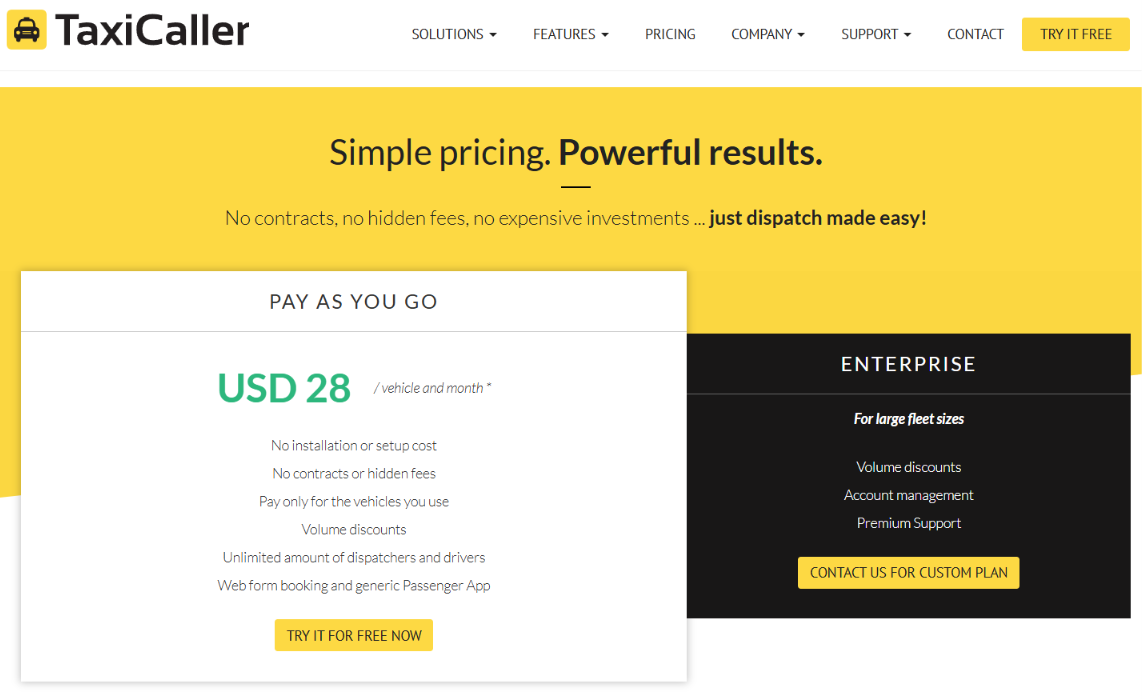
Meet TaxiCaller, a SaaS taxi dispatch platform that offers booking, dispatch, and fleet management tools for ride-hailing businesses. For U.S.-based companies, pricing starts at around $28 per vehicle per month. The company operates on a pay-as-you-go model with no setup fees, installation costs, long-term contracts, or hidden charges, at least according to its website. If you want a branded passenger app with your own company name, colors, and identity, that comes at an additional cost.
Now let’s do the math.
| At 50 drivers | Monthly | Annual |
|---|---|---|
| Base platform fee ($28 × 50) | $1,400 | $16,800 |
At this scale, TaxiCaller is genuinely affordable. To be fair, TaxiCaller also mentions in its FAQ that larger fleets receive discounts, so companies operating more than 20 vehicles will probably pay a lower per-vehicle rate.
| At 200 drivers | Monthly | Annual |
|---|---|---|
| Base platform fee ($28 × 200) | $5,600 | $67,200 |
Still doesn’t sound too painful. But that’s year one. What happens in year four when your fleet doubles?
We’ll come back to that later. Now let’s look at one more taxi app booking platform – TaxiDex. Their Basic plan (dispatch and admin panel only, no driver app, no passenger app) runs $15 per driver per month. The Pro plan adds white-label driver and passenger apps plus driver wallet management at $25 per driver per month. There's also a Partner plan with no monthly fee, but a 10% commission taken on every ride.
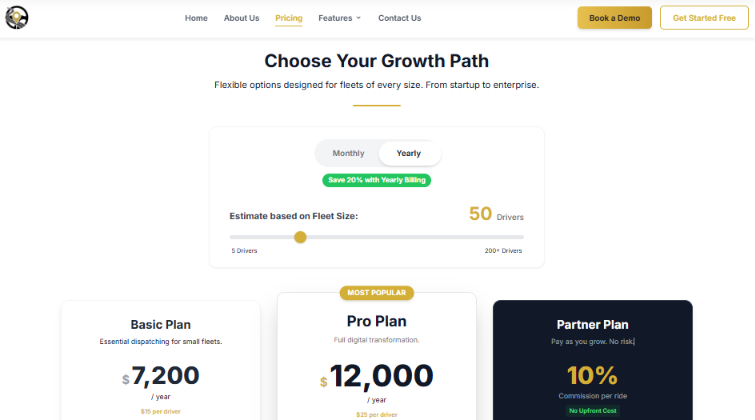
Here's what that looks like at the two fleet sizes we've been tracking:
| Monthly | Annual (save 20%) | |
|---|---|---|
| 50 drivers (Basic/Pro) | $750/$1,250 | $7,200/$12,000 |
| 200 drivers (Basic/Pro) | $3,000/$5,000 | $28,800/$48,000 |
Path 2. Custom taxi booking app
When you search online, most companies give broad custom taxi app development cost ranges without many specifics. And that does make sense. A reliable estimate appears once the team understands your fleet size, dispatch workflows, integrations, regions, and feature requirements.
We do the same. At Stfalcon, we won't give you a number before we understand what you're building. When it comes to taxi service app development cost in 2026, a dispatch upgrade for an existing fleet looks different from an Uber-like app built from zero, or a Lyft-style platform with custom pricing and driver management logic. When we know the scope, the number becomes reliable. Our typical range is $80K–$120K, plus roughly 15% annually for maintenance.
But once the platform is yours, it’s yours. You don’t pay for every new driver added or extra integration, which you can’t say about SaaS.
Taxi mobile app development cost comparison: What the initial SaaS fee doesn't tell you
When reviewing SaaS taxi platforms, you’ll usually see one big number screaming at you from the pricing page: something like “$15 per driver/month” or “$99 monthly support fee.”
At first glance, it feels like that’s the total cost. But it’s not. First, the cost grows with your fleet. More drivers, more rides, more dispatchers → higher monthly bills. Second, many SaaS vendors include additional costs that are technically public, but often buried deeper in the pricing structure.
Here’s what often sits underneath that nice monthly price.
- Per-ride fee. Some platforms layer a per-ride fee as a part of the cost. For example, Onde. Their Professional plan includes a monthly support fee ($99), a one-time onboarding fee ($8,500), and an additional percentage taken from every ride completed through the platform. None of this is secret pricing, but you shouldn’t underestimate how quickly the per-ride fee grows once the business starts scaling.
- Dispatch integration costs. Connecting a SaaS platform to your existing fleet management system, ERP, or driver HR tools requires either native integrations (which may not exist), custom middleware development (which you pay for separately), or manual processes that create operational drag.
- Missing-feature workarounds. Every feature your operation needs that isn't on the vendor's roadmap becomes a manual process or a separate software cost. These accumulate in complex operations, like custom zone logic, corporate account billing, driver tier systems, or fuel surcharge management.
- Vendor roadmap dependency. The vendor's roadmap isn't yours. It belongs to every customer the vendor has. When you need a feature, you wait, or you build around it manually, which is a cost that isn’t on the invoice.
Not every SaaS platform will hit you with all of these. But before you sign, know exactly what's in the contract and what isn't. Year one is easy to model. It's year three that surprises people.
Answer ten questions about your operation. You get a year-by-year comparison of your current SaaS spend against a custom logistics platform built once and owned outright, module by module. Based on Stfalcon's own project-estimation methodology.
Takes about 3 minutes. 17+ years in transportation & logistics stand behind the math.
Custom taxi booking app development cost sounds expensive until you do the math
SaaS usually wins the first-year comparison. But later… the numbers can get puzzling, to say the least.
We’ll compare the platforms we mentioned earlier, TaxiCaller and TaxiDex, against custom app development and see how the numbers behave over time. For the custom development scenario, we’ll use a $100,000 development cost (the average of our typical $80K–$120K range), plus annual maintenance equal to 15% of the initial project cost starting from year two.
| 200 drivers | Year 1 | Year 3 (cumulative) | Year 5 (cumulative) |
|---|---|---|---|
| TaxiCaller ($28/driver) | $67,200 | $201,600 | $336,000 |
| TaxiDex Pro ($25/driver) (20% off yearly plans) | $48,000 | $144,000 | $240,000 |
| Custom build | $100,000 | $130,000 | $160,000 |
Now, let’s consider the scenario if your fleet grows. Imagine that by year three you’ve reached 400 drivers, and by year five, 500.
| TaxiCaller ($28/driver/month) | TaxiDex Pro ($25/driver/month, annual 20% off) |
|---|---|
|
Year 1 (200 drivers): $28 × 200 × 12 = $67,200 Year 2 (200 drivers): $28 × 200 × 12 = $67,200 Year 3 (400 drivers): $28 × 400 × 12 = $134,400 Year 4 (400 drivers): $134,400 Year 5 (500 drivers): $28 × 500 × 12 = $168,000 Cumulative Year 3: $67,200 + $67,200 + $134,400 = $268,800 Cumulative Year 5: $268,800 + $134,400 + $168,000 = $571,200 |
Year 1 (200 drivers): $25 × 200 × 12 = $60,000 − 20% = $48,000 Year 2 (200 drivers): $48,000 Year 3 (400 drivers): $25 × 400 × 12 = $120,000 − 20% = $96,000 Year 4 (400 drivers): $96,000 Year 5 (500 drivers): $25 × 500 × 12 = $150,000 − 20% = $120,000 Cumulative Year 3: $48,000 + $48,000 + $96,000 = $192,000 Cumulative Year 5 annual: $192,000 + $96,000 + $120,000 = $408,000 |
If scrolling through numbers in the above table isn’t your thing, here’s the short version.
| Year 1 (200 drivers) | Year 3 400 drivers (cumulative) | Year 5 500 drivers (cumulative) | |
|---|---|---|---|
| TaxiCaller ($28/driver) | $67,200 | $268,800 | $571,200 |
| TaxiDex Pro ($25/driver) (20% off yearly plans) | $48,000 | $192,000 | $408,000 |
| Custom build | $100,000 | $130,000 | $160,000 |
Like we expected, custom development costs more in year one. By year three, it's already the cheapest option on the table. The more you scale, the more the math works in custom's favour. We've seen this happen in real projects. Here's how it was.
Building a cost-effective ride-hailing platform for BBGO
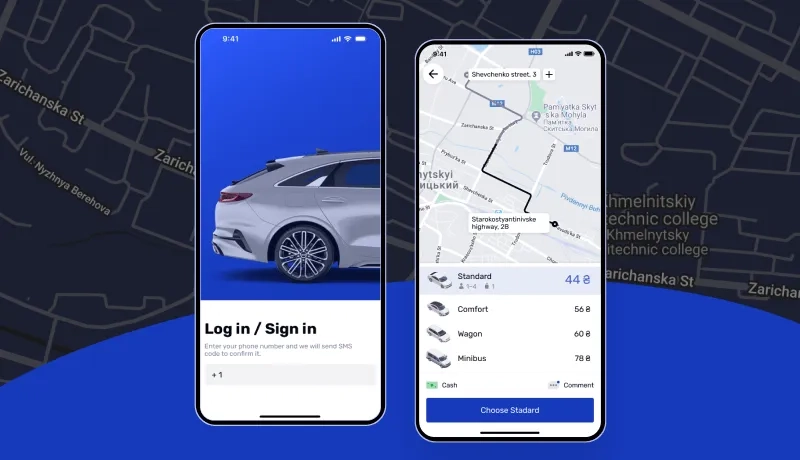
BBGO is a taxi company with over 15 years on the market. For a while, they ran on a SaaS solution for taxi services. It worked in the early stages, but as the business grew, the platform became too expensive. Meanwhile, competitors like Bolt were gaining ground with slicker apps. BBGO needed a custom taxi booking app, and needed it fast.
 Read the full case study
We built a full ride-hailing system, including:
- Passenger app with real-time tracking and multiple payment options
- Intuitive driver app for minimal screen interaction
- Admin panel with zone-based dynamic pricing.
When cloud costs spiked mid-project, we migrated the entire infrastructure from Google Cloud to Hetzner without a single disruption to live operations. Today, BBGO handles 50,000+ orders monthly without any SaaS limitations.
Need a custom taxi app, not an Uber clone?
Let's scope it for your fleet.
Alina
Client Manager
Why 'custom is slower' is also the wrong assumption about custom taxi app development cost
The final objection against custom usually sounds like this: "Even if custom is cheaper long-term, we can't wait 12 months to launch."
This objection was reasonable when every custom taxi app started from a blank file. That’s no longer how it works.
Stfalcon has spent 16+ years providing taxi booking app development services, so we already have reusable logistics modules for booking engines, dispatch systems, user verification, BI dashboards, payment infrastructure, and other operational components. We also use AI-powered SDLC practices to speed up delivery and reduce development overhead.
| Speed up development with AI | ||
|---|---|---|
| Auto-generate code for standard tasks | Detect bugs in builds before deployment | Create CI/CD pipelines tailored for transportation platforms |
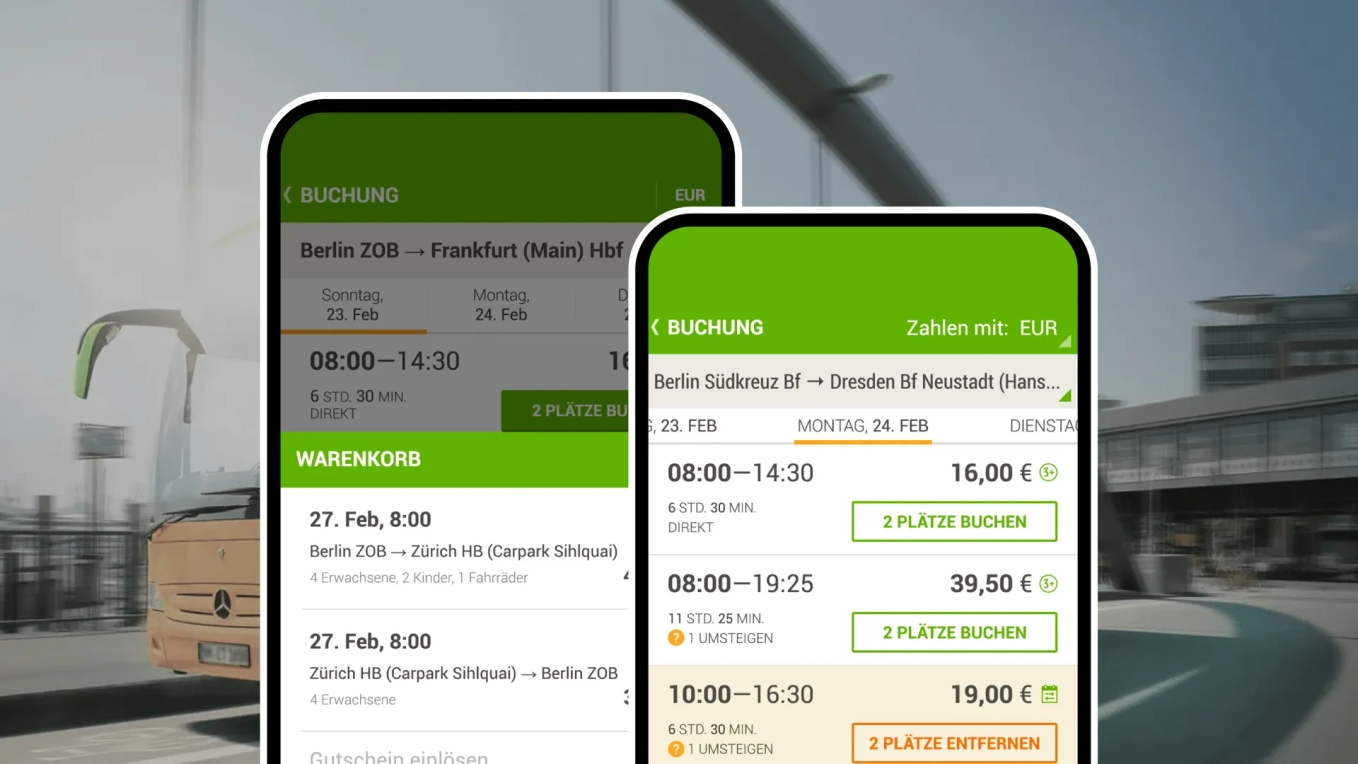
Unlike generalist teams, we don’t have to learn logistics on your budget. We’ve built a bus booking system serving 8M passengers across 1,300+ routes with real-time route data, seat availability, multi-platform support across web and mobile, live bus tracking, and partner portals for fleet operators. The client went from prototype to capturing 38.5% of Germany's intercity bus market in three years.
 Read the full case study
Projects like this don't happen on rented infrastructure. But in any case, you need to think several steps ahead to understand what’s better for you, SaaS or custom.
Run the numbers before you sign
We're not here to sell you a custom app you don't need. SaaS is the right call for plenty of operations, and we'll be the first to tell you if yours is one of them. Here's a quick way to know where you stand.
Start with SaaS if your fleet is under 50 drivers, you need to launch fast, and you're not yet sure how the operation will scale.
Start building custom if you're above 100 drivers, your SaaS bill has become a real budget line, or you've hit a feature wall that the vendor's roadmap won't fix this year.
Move to custom now if you're above 150 drivers, you're expanding to a second market, or you've done the three-year math, and SaaS doesn't win past year two.
Build custom from the start if you already know your fleet will scale past 200 drivers, you need dispatch logic or pricing rules the SaaS platforms don't support, or you're entering a market where owning the platform is a competitive advantage.
Whichever path you choose, make sure your decision is grounded in numbers you’ll still be comfortable with in year three.