No transit operator typically starts with a custom build. You buy SaaS because it gets you live fast. Plus, when your routes are simple and booking volume is low, a ready-made platform works fine. The economics often begin to shift around 50K monthly bookings.
50K+ is when a predictable per-booking fee becomes a compounding tax on your own growth. The feature gaps you used to tolerate turn into operational bottlenecks. You've outgrown the platform's limits, but you're still paying enterprise premiums to stay locked inside them.
Stfalcon has spent 16+ years working with logistics and transportation companies, helping them overcome these scaling challenges with a 99% success rate across 378 projects. For example, our bus ticket booking app development company built the core architecture that took MeinFernbus to 8M passengers across 1.3K+ routes, and rebuilt Ecolines's booking app, which doubled their ticket sales post-launch.
Further, we’ll tell you where SaaS economics break, what a custom platform costs to build and run, and how to spot your tipping point before the system snaps.
TL;DR
Why do SaaS bus booking platforms break at scale?
Most commercial booking platforms charge based on your volume. For example, Rezdy charges a fixed monthly subscription alongside booking fees up to 3% at checkout.
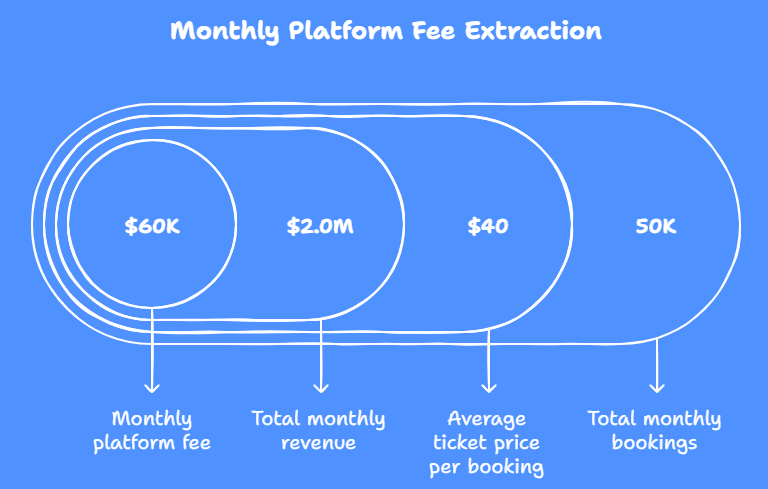
At 50K monthly bookings with a $40 average ticket, a 3% platform fee extracts $60,000 a month ($720,000 a year) from revenue before payment gateway costs. Speaking of payment gateways, they take an extra 2.9% + $0.30 cut per transaction. For long-distance bus operators, these compounding percentages turn into a direct tax on your own passenger volume.
But transaction fees are only the visible part of the bill. The real bleeding happens off the balance sheet, through the SaaS Cost Multiplier, the total financial burden of volume fees plus everything your internal team absorbs to bridge the gaps between what the vendor ships and what your routes actually require.
Based on internal transport operation audits and TCO assessments, these invisible layers can add 30–60% on top of the headline transaction fee, depending on operational complexity.
At scale, the invisible tax breaks down into 5 operational layers:
The integration tax
Vendors advertise open APIs but deliver generic schemas. If their data structure doesn't match your TMS or dispatch engine, your developers build custom middleware to map the gap. If one engineer spends one day a week maintaining broken data feeds and updating that middleware every time the vendor changes something, that adds roughly $20,000 a year in absorbed labor — a permanent premium on top of your software bill, just to keep basic systems communicating.
The spreadsheet tax
SaaS platforms target the median operator. The moment you introduce multi-stop intermediate pricing, route-specific fare rules, or demand-responsive GTFS-Flex compliance, the platform hits a wall. Your operations team ends up exporting raw data and managing schedules manually in spreadsheets, introducing severe human error risks.
The scaling penalty
Volume discounts are structured to protect the vendor's margin, not yours. Once you reach 50K+ monthly bookings, per-booking fees become a structural liability. When renewal comes, the cost of migrating booking history and retraining staff gives the vendor negotiating leverage you don't have. The platform knows you're embedded and the price reflects it.
The roadmap delay
When you need an operational feature, the vendor schedules it for "Q3 next year." A delay in GTFS schedule updates means your routes disappear from Google Maps and Apple Maps. A delay in multi-depot pricing means your team routes blind while you pay full price for software that can't do the job.
The exit cost
Leaving a platform after two or three years is expensive, regardless of how good the reason. Extracting booking history from proprietary schemas, rewriting custom API integrations, and retraining operational staff creates a significant capital drain that never appears in the original contract. It accumulates with every route and channel you add.
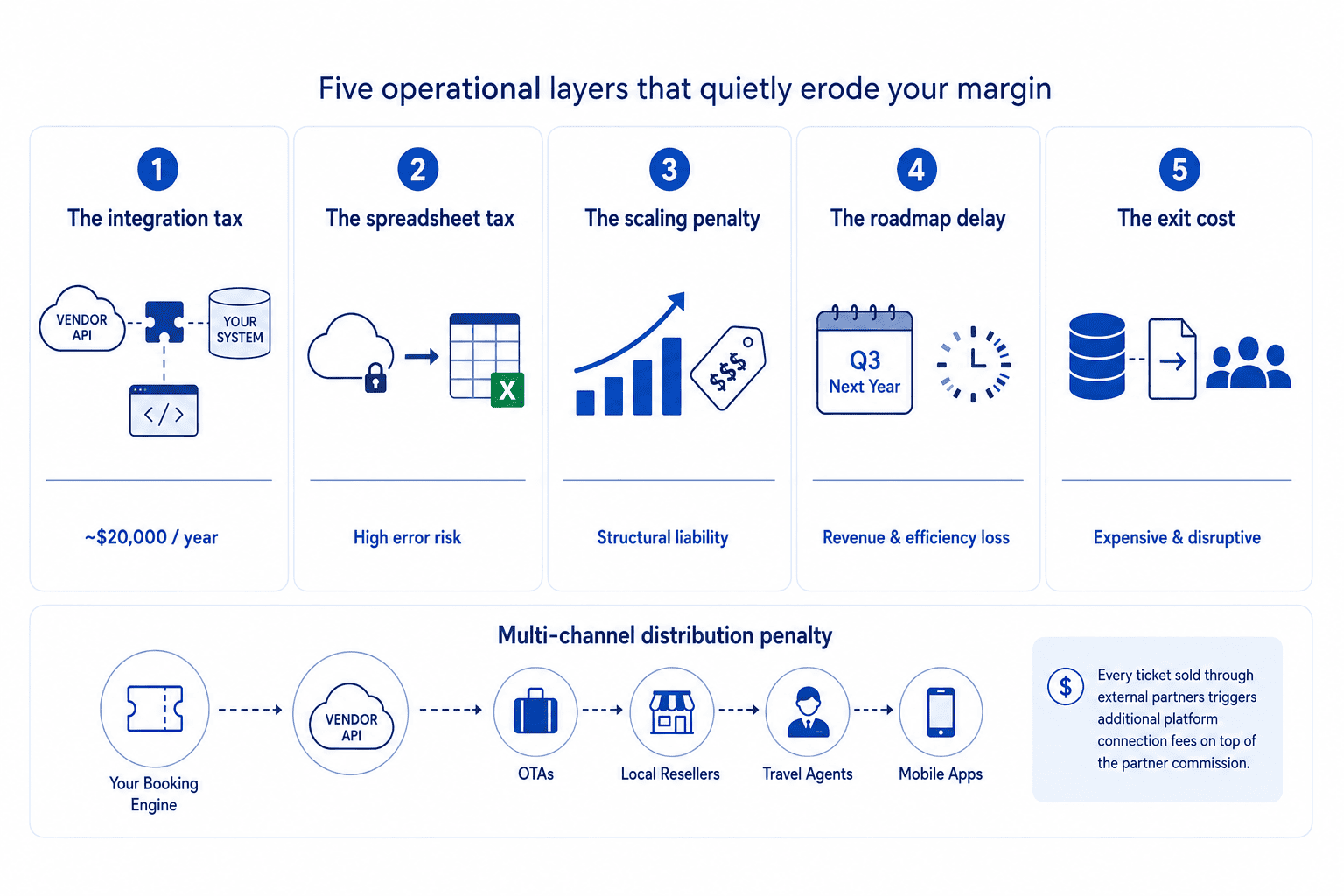
Commercial platforms also penalize multi-channel distribution. If you connect your booking engine to OTAs or local resellers via the vendor's API, they layer on additional third-party connection fees. Every ticket sold through an outside partner triggers a platform charge on top of the commission you're already paying that partner.
Overall, SaaS doesn’t mean bad software, but it has an expiration date. The only question is whether you build your alternative before or after it starts costing you more than it saves.
The bus ticket booking app cost if you opt for a custom build
Building a custom bus booking platform is an architecture decision that shapes what your operation can do for the next five to seven years. The cost we provide below reflects that scope, calculated using Eastern European senior engineering rates ($44–$50/hr for system architects; $35–$40/hr for senior feature engineers).
The price of figuring it out as they go doesn't apply here. When a generalist development team builds a booking platform, they charge you for their learning curve as well, which includes domain research, incorrect assumptions about route logic, fare rule edge cases, and multi-currency payment compliance gaps. With a team that's been building passenger transportation software for 16+ years like ourselves, that cost is already paid.
The pre-built foundation modules Stfalcon has developed and used through projects such as MeinFernbus and Ecolines (e.g., route management engines, seat inventory logic, multi-currency payment flows) mean the project doesn't start from scratch on infrastructure that's already been proven at scale.
| Tier | Included scope | Team & timeline | Estimated cost |
|---|---|---|---|
| Foundation tier | Core booking engine, fixed route/schedule management, standard payment processing, single currency, web interface. | 5–7 engineers 5–7 months | $120,000–$200,000 |
| Mid-tier | Foundation + iOS/Android apps, multi-currency/region fares, OTA & reseller APIs, GTFS schedule export, operator dashboard. | 7–10 engineers 7–9 months | $220,000–$380,000 |
| Full-scale platform | Mid-tier + real-time seat sync, dynamic pricing engine, GTFS-realtime, multi-carrier support, enterprise white-label API. | 8–12 engineers 9–14 months | $380,000–$650,000 |
Infrastructure costs (annual, post-launch)
Here is an approximate cost of a baseline cloud infrastructure for a mid-scale platform (50K to 100K monthly bookings) with real-time seat availability and multi-region deployment:
| Component | Monthly cost |
|---|---|
| Managed database (Amazon RDS Multi-AZ) | $200 – $400 |
| Redis cache (Amazon ElastiCache) | $80 – $150 |
| Application servers (2–4 Amazon EC2 Instances via Auto Scaling) | $200 – $500 |
| CDN and storage (Amazon CloudFront + S3) | $50 – $100 |
| Total infrastructure | $530 – $1,150/month ($6,400 – $13,800/year) |
These estimates assume moderate traffic patterns and exclude enterprise-level monitoring, dedicated infrastructure teams, data warehouse costs, and third-party API fees.
If your volume scales to 500K monthly bookings with high-concurrency searches, seat availability checks, payment processing, and multi-region deployment, infrastructure will naturally increase to $3,000–$8,000/month depending on redundancy configuration.
Ongoing maintenance follows the standard industry benchmark of 15–20% of initial development cost per year — covering security patching, dependency updates, performance optimization, and incremental feature work. On a $300,000 build, that's $45,000–$60,000/year.
How much does it cost to build a bus ticket booking app vs. sticking to SaaS
The per-booking fee tells you what your platform costs this month, leaving you without any clue what it costs to run a passenger transportation operation on SaaS three years down the line.
To evaluate long-term ownership, we use the build-to-own advantage model — a 3-year financial framework comparing compounding SaaS fees against a custom asset:
3-year TCO comparison (USD)
Baseline: An operator processing 50K monthly bookings at an average $40 ticket, scaling at 10% annually.
| Year 1 | Year 2 | Year 3 | ||||
|---|---|---|---|---|---|---|
| Cost Category | SaaS | Custom | SaaS | Custom | SaaS | Custom |
| Platform fees / Hosting | $720,000 | $7,200 | $792,000 | $7,500 | $871,200 | $7,800 |
| Build / Development | $0 | $300,000 | $0 | $0 | $0 | $0 |
| Maintenance | $0 | $0 | $0 | $45,000 | $0 | $45,000 |
| Manual workarounds | $25,000 | $0 | $32,500 | $0 | $42,000 | $0 |
| Annual total | $745,000 | $307,200 | $824,500 | $52,500 | $913,200 | $52,800 |
| Cumulative TCO | $745,000 | $307,200 | $1,569,500 | $359,700 | $2,482,700 | $412,500 |
Illustrative model only. SaaS costs assume a 3% transaction fee on booking value, based on 50K monthly bookings at a $40 average ticket, with 10% annual booking growth. Custom costs assume a $300,000 mid-tier platform build, annual infrastructure costs, and ongoing maintenance at approximately 15% of initial development cost per year. Actual costs will vary depending on platform complexity, integrations, and other factors.
The upfront capital investment in Year 1 is significant, and it is the primary reason many operators hesitate to build. However, when you look at the 36-month horizon, the financial math changes drastically.
The financial crossover happens much faster at higher volumes. At 500K monthly bookings, even a 1% platform fee represents more than $2.4M annually, turning software into your heavy operational burden.
Already past the SaaS options?
Tell us about your current infrastructure, and we’ll design a custom architecture blueprint with a realistic 3-year cost picture.
Alina
Client Manager

Here is a look at how this structural shift translates into real-world growth and market expansion.
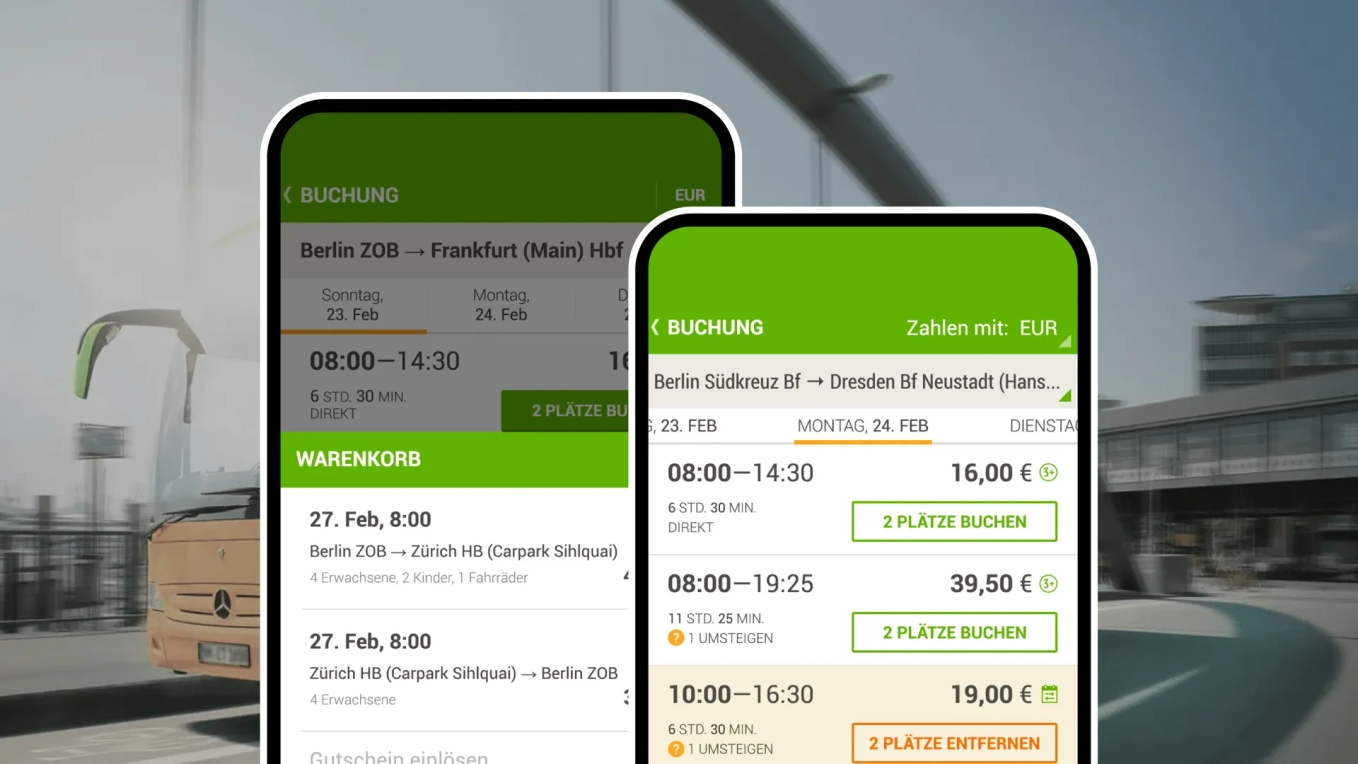
Case in point #1. How Stfalcon helped build the foundation for a custom bus ticket booking platform that won over 40% bus market share
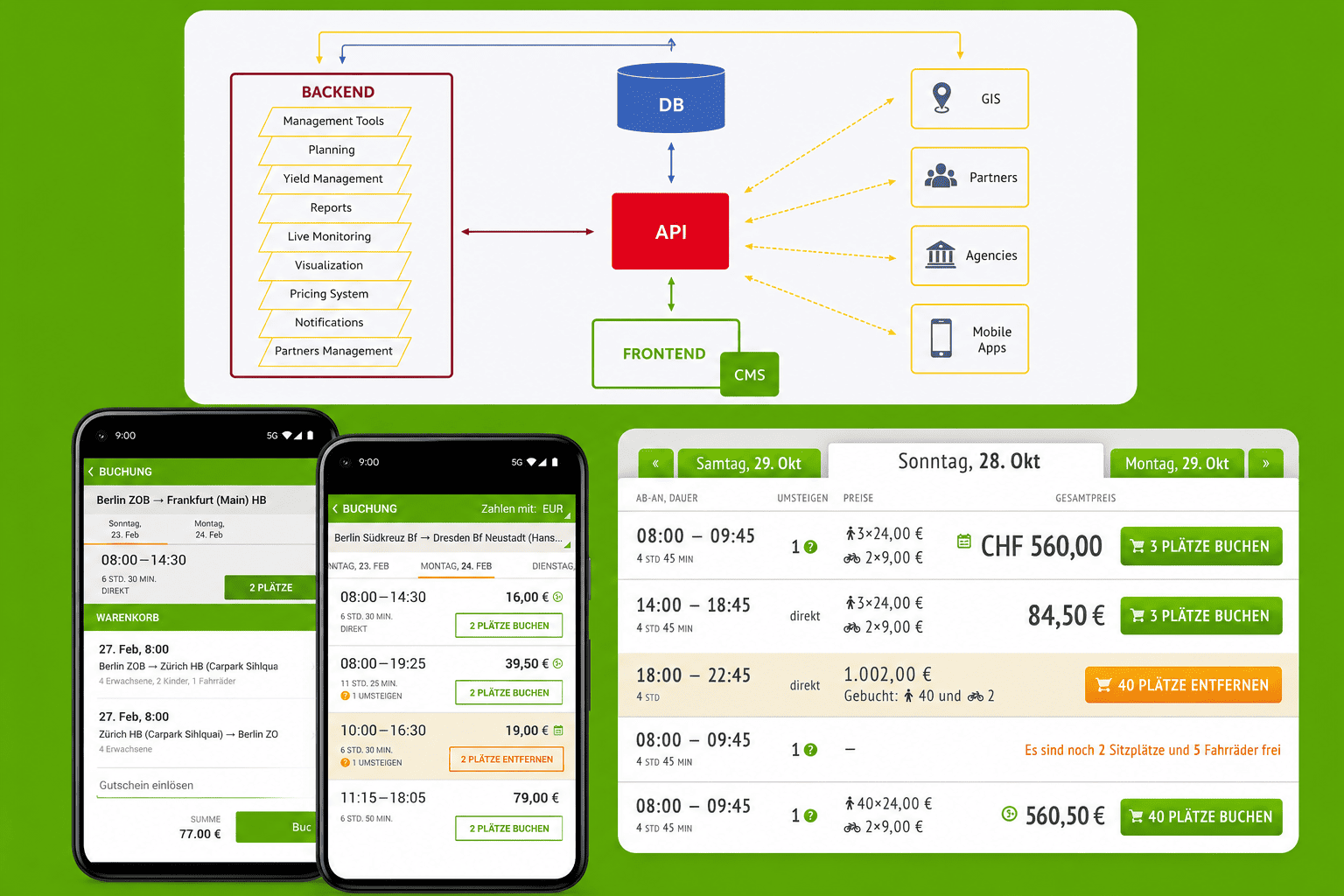
When Germany lifted its decades-old ban on intercity buses in 2011, MeinFernbus was looking to build a booking platform that could handle live routing, seat availability, and partner integrations from day one before the market even officially opened.
No off-the-shelf system covered that scope, so Stfalcon built the core architecture from the first prototype. The reusable API structure later let the MeinFernbus team deploy their iOS bus ticket booking app fast, skipping redundant backend work entirely.
 Read the full case study
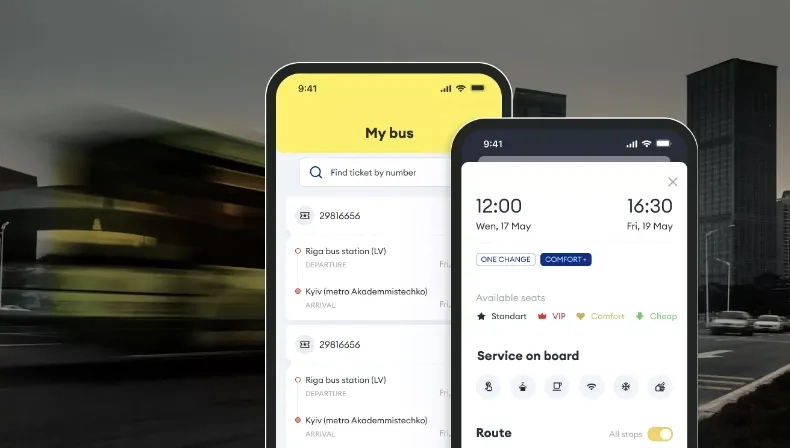
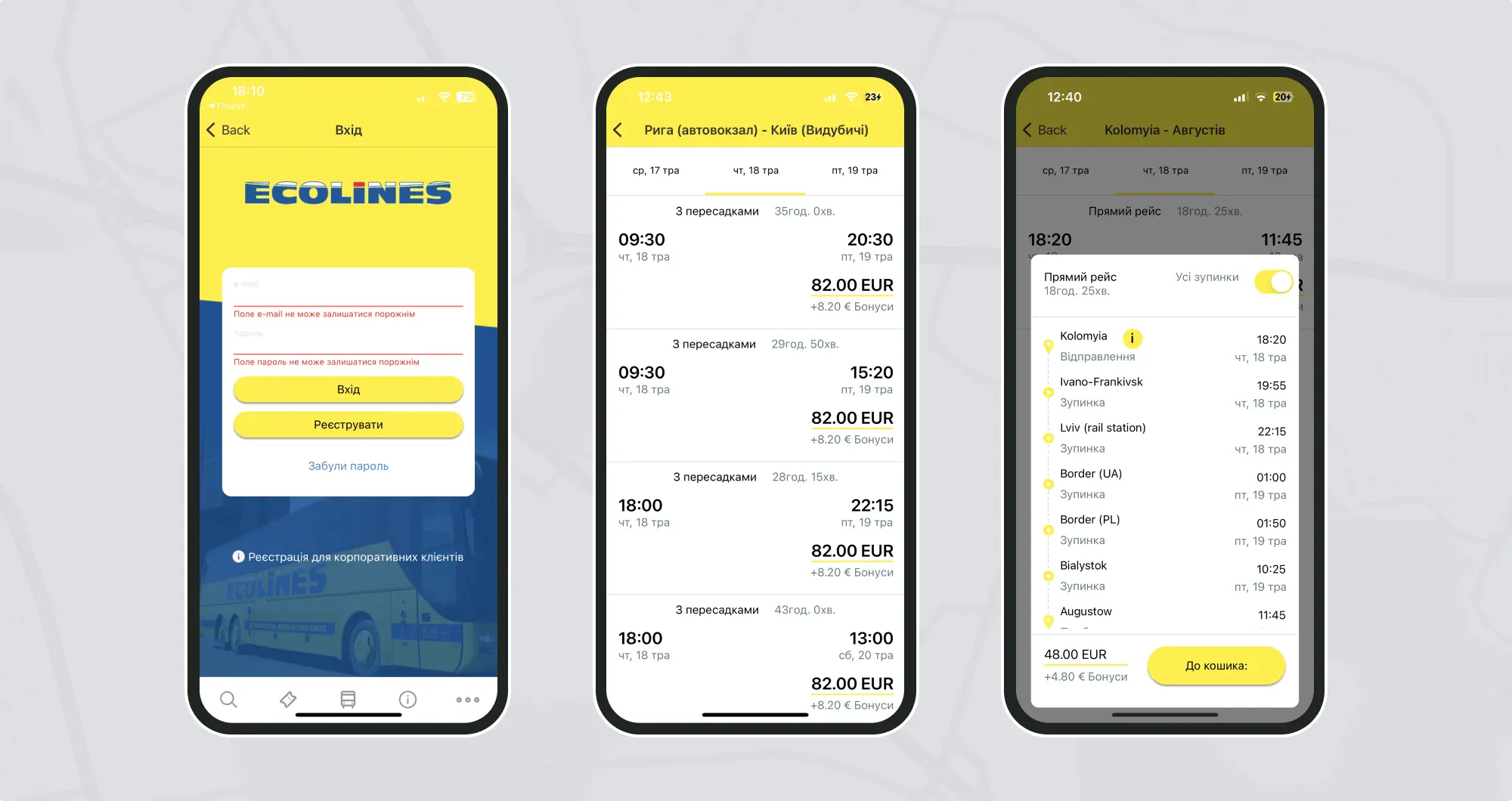
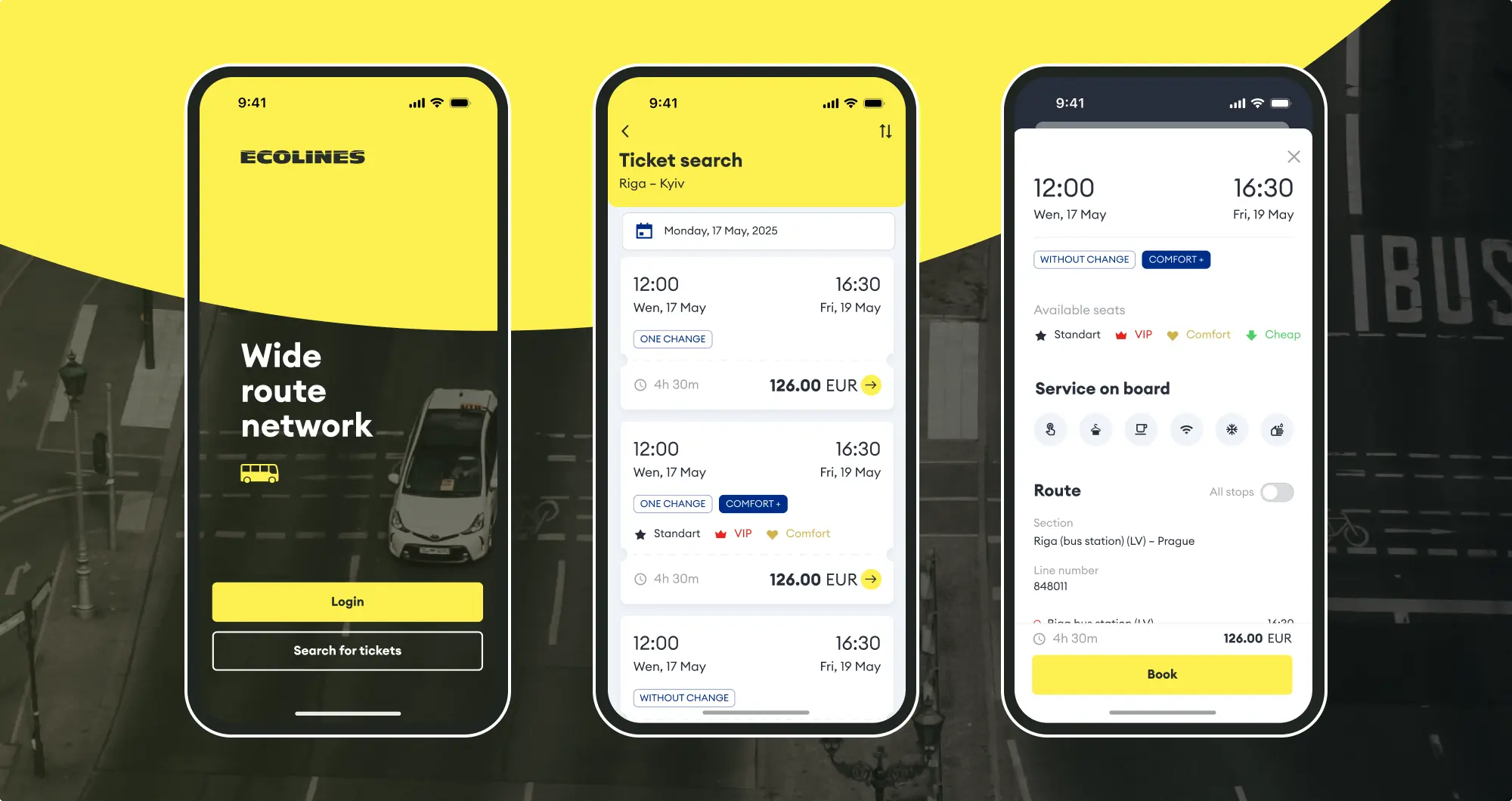
Case in point #2. App infrastructure upgrade for Ecolines: A 100% lift in mobile ticket sales
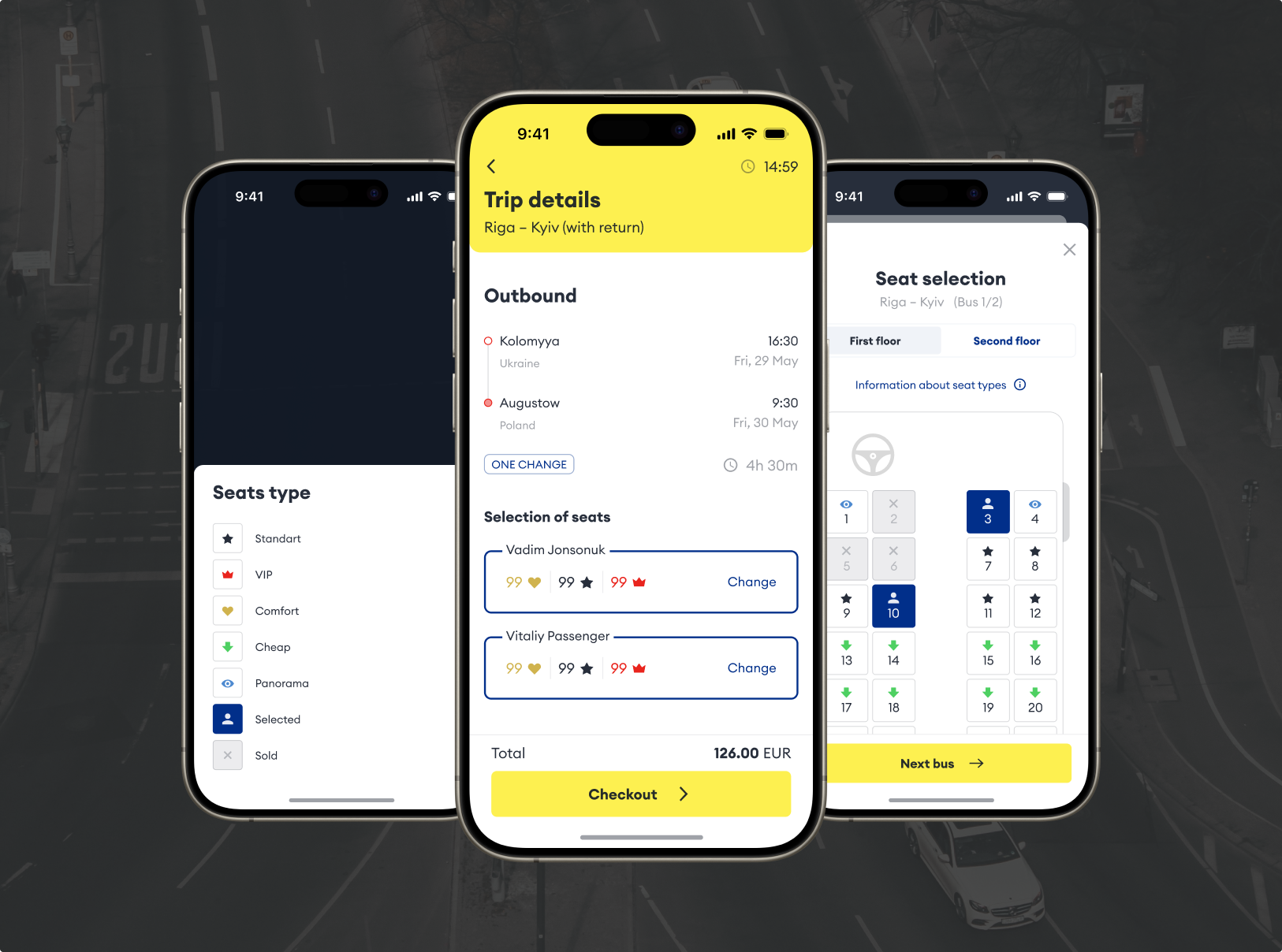
Ecolines, one of Europe’s largest coach operators, saw a sharp drop in mobile sales due to legacy infrastructure. The old app, built on Ionic, suffered from constant freezes and broken Google Pay integrations. The company needed an app revamp with a smooth checkout experience to restore passenger trust.
Stfalcon audited the backend, mapped clean API documentation, and migrated the platform to the high-performance Flutter framework. This shift eliminated payment crashes and simplified the passenger journey. As a result, the overhaul delivered a 100% increase in conversion rates post-launch.
 Read the full case study
When does custom build make sense — and when not?
Custom transportation software development requires serious capital. It is not a default choice for every transit operator, especially if you’re just starting out.
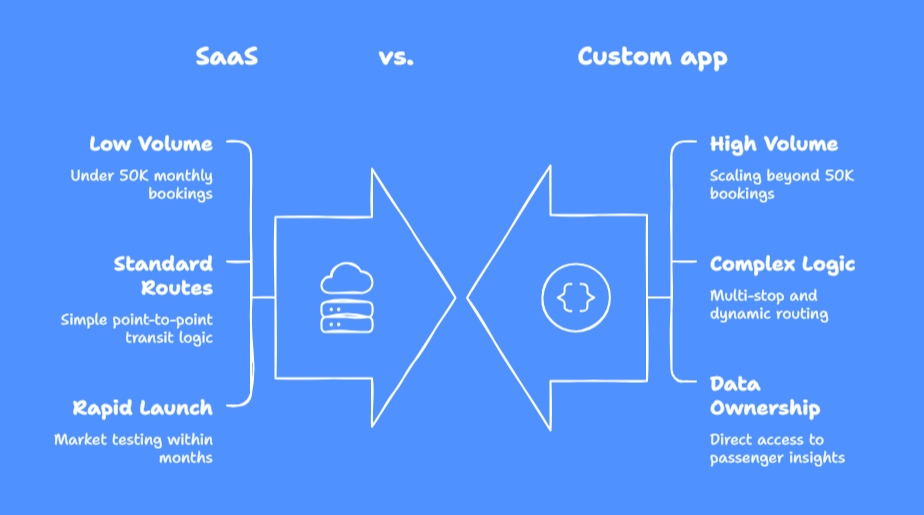
Go with SaaS if:
- Your volume is low. You process under 50K monthly bookings. At this stage, transaction fees are cheaper than engineering costs.
- Your routes are standard. You run simple point-to-point lines without complex logic.
- Speed is everything for you. You need to launch within 1–3 months to test a market or run a seasonal route. SaaS is the ideal tool to validate product-market fit.
Switch to custom if:
- Fees are starting to get high. If you are crossing the 50K-booking monthly threshold, and per-booking SaaS fees turn into a major line item, that’s a sign you need to consider a custom solution.
- Your routes outgrow the platform. You manage multi-stop routing, dynamic pricing, or regional fare rules. If your team is constantly fighting platform limitations manually, you are already paying for a custom build — making professional mobile app development services the smartest next move for your transportation core.
- Data ownership matters. Dynamic pricing, demand forecasting, and route depend on direct access to your booking and passenger data. On your own platform, you own the full dataset, without any vendor in the middle.
Timeline rule: SaaS is perfect for a 12-month MVP or small operators. However, if you are planning for 3+ years of aggressive growth and already hitting platform limits, start scoping now. A custom migration takes 7–9 months. Waiting until your SaaS platform becomes a bottleneck usually means migrating under pressure. And rushed migrations are rarely cheap.
When to stop paying SaaS subscriptions
The criteria are clear, and the decision comes down to your current growth stage:
- If you are testing new regions or staying under the 50k booking limit → Keep using SaaS. It’s the most cost-effective way to run standard routes without heavy upfront investments.
- If platform fees are draining your margins or generic software forces your team into manual workarounds → It’s time to step off the subscription treadmill.
The next practical step is to calculate the real cost of ownership based on your specific route logic, transaction volume, and scaling plans.
Reach out to us and tell more about your project, and we'll prepare a realistic breakdown of your development budget, migration roadmap, and future 3-year cost picture.
Ready to build a custom bus ticket booking app?
See how our 16+ years of logistics expertise can help your business leave restrictive SaaS subscriptions behind
Alina
Client Manager
FAQ
What is the average bus ticket booking app development cost?
A custom engineering budget depends on your system's operational architecture. A foundation-tier build — web-only, single currency, standard fixed routes — runs $120,000–$200,000. A mid-tier platform covering multi-region route management, native iOS/Android apps, OTA integrations, and GTFS export runs $220,000–$380,000. Full-scale platforms with dynamic pricing, GTFS-Realtime feeds, multi-carrier support, and white-label API access start at $380,000 and scale with complexity.
How much does it cost to build a bus ticket booking app with complex routing?
Advanced routing features (multi-stop intermediate pricing, dynamic fare rules, GTFS-Flex compliance for demand-responsive services) add approximately $20,000–$35,000 to a foundation-tier build, depending on the number of route variants and the fare logic constraints. This is the scope that SaaS platforms consistently handle poorly, making it the most common trigger for operators moving to custom.
How much does it cost to build a bus ticket booking app vs. staying on SaaS?
At 50K monthly bookings with an average $40 ticket, the 3-year cumulative cost on a SaaS platform (at 3% per booking plus manual workaround labor) runs approximately $2.48M. A custom-built mid-tier platform for the same operation runs approximately $412,500 over the same period — a $2.07M difference by Year 3. From Year 4 onward, the custom platform costs roughly $59,000/year in infrastructure and maintenance. SaaS fees continue to compound with every booking.
What key factors influence the total bus ticket booking app cost?
The four variables that move the number are:
- functional complexity (fixed routes versus dynamic pricing and multi-stop logic), third-party integrations (OTA channels, TMS, dispatch systems, GTFS compliance),
- team seniority and logistics domain experience,
- build approach (developing core modules from scratch is far more expensive than adapting existing, field-tested foundations.)
A team with existing transportation software modules delivers faster and at a lower total cost than a generalist team starting from zero.
What is the bus ticket booking app development price for a GTFS-compliant platform?
GTFS Schedule compliance, the standard format used by Google Maps, Apple Maps, and most multi-modal trip planners, is included in a mid-tier build scope. GTFS-Realtime, which provides live vehicle positions and arrival time updates, requires additional infrastructure: a real-time data pipeline from vehicle hardware to the API feed, a feed validation layer, and ongoing maintenance as the specification updates. Depending on route count and hardware integration complexity, this adds approximately $30,000–$60,000 to the mid-tier scope.