
When you evaluate SaaS fleet management software, the math is simple: review a few options, check the pricing page, multiply the cost by the number of vehicles, and set the budget. If pricing isn't public, you request a quote.
As an outcome, what you typically see on the pricing page is $25-$45 per vehicle/month. So at first glance, even a large fleet looks affordable and easy to justify.
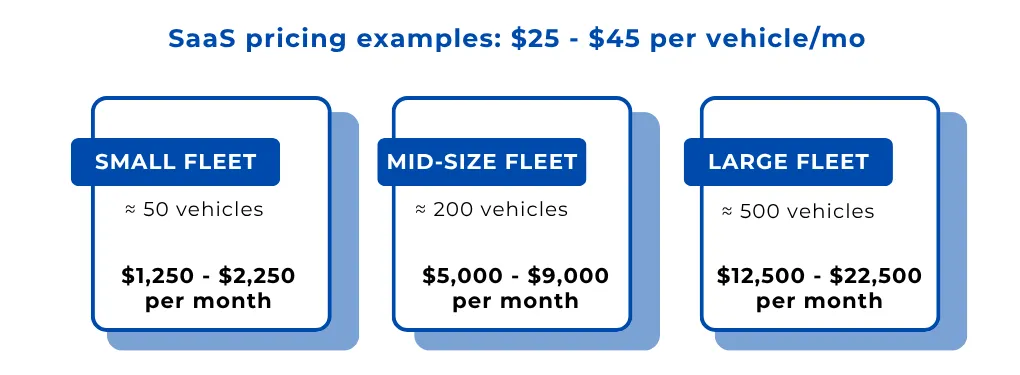
But that subscription price covers only the starting point. The final cost includes the broader operational stack with integrations, additional modules, and customization. In other words, the subscription price and the real operational cost are two very different numbers.
Below, we explain why SaaS fleet management pricing looks cheaper at first and how to estimate the real cost when every platform promises anytime, anywhere visibility for just a few dollars per vehicle.
TL;DR
- SaaS fleet platforms advertise $25-45/vehicle/month, but it's only the entry price. Real fleet software costs grow as companies add telematics hardware, AI dashcams, asset trackers, integrations, and extra modules.
- Most fleets need 5-7 different tools to cover dispatching, maintenance, fuel management, compliance, and asset tracking, each adding its own cost.
- Setup and onboarding often come with extra fees not visible on pricing pages (when those pages show prices, of course).
- Custom fleet management software works differently: companies pay once for development and then maintain the system annually instead of paying per vehicle.
- Depending on scope, custom fleet platforms start at around $35,000 for maintenance-focused systems and $80,000+ for full operations management platforms.
- Companies switching from SaaS stacks to custom platforms cut total software costs by 40-60% over five years.
Fleet management software cost: Your fleet needs 5-7 systems. And each adds its own cost
The often-quoted fleet management price range in 2026 is $25-$45 per vehicle per month buys you GPS tracking, a map view, and a dashboard at best. As companies begin operating, they discover the platform doesn't handle dispatching or that fuel management is a separate add-on. So they start buying more tools and as a result get 5 to 7 different modules, each bringing another line to the monthly bill.
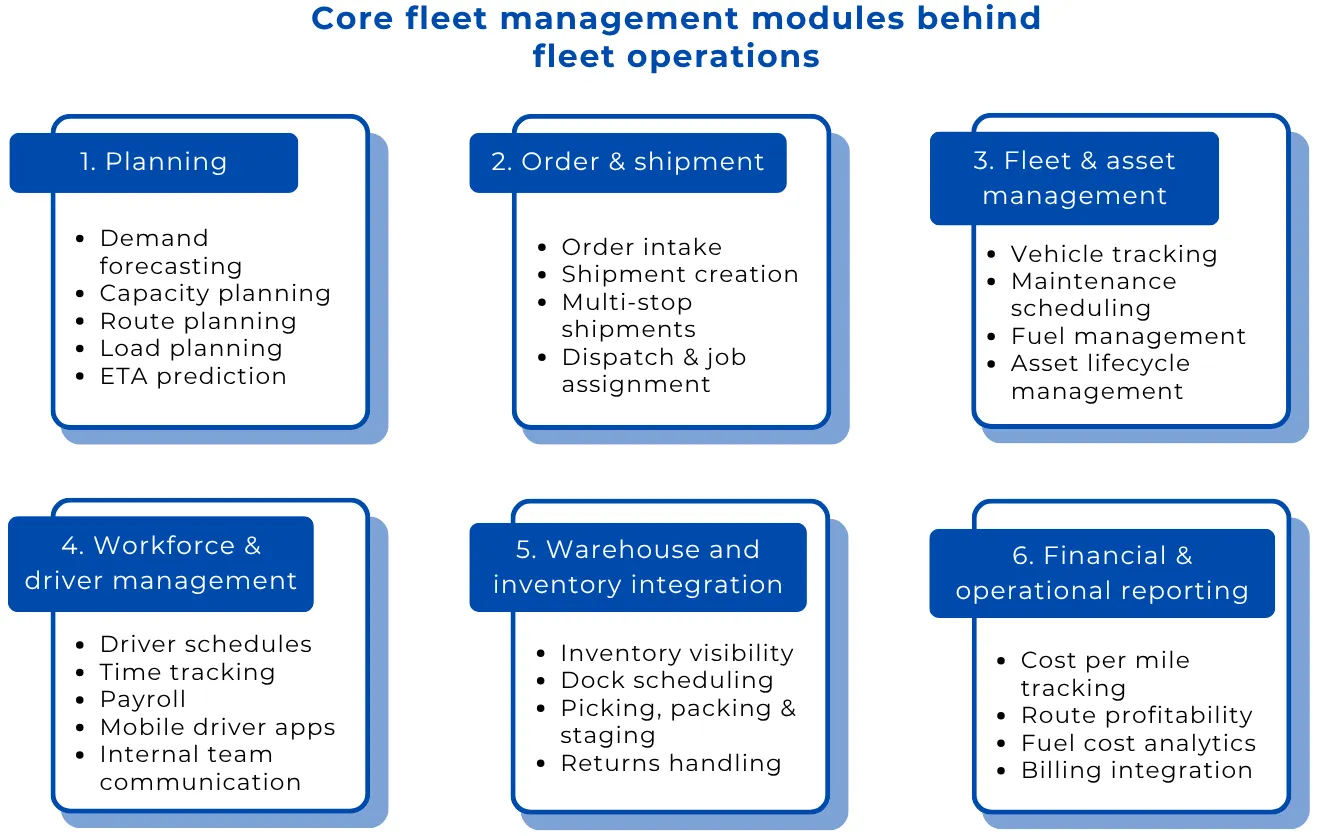
Take Geotab, one of the best-known fleet management platforms. Like many vendors, it doesn't publish exact pricing. From its FAQ, we know the cost includes the Geotab GO device plus a monthly subscription. So before you even get to the software fee, there's hardware to account for. On top of that, Geotab has a Marketplace with third-party and Geotab-developed software and hardware solutions, which, of course, cost extra.
Then there's Fleetio. Pricing starts at about $4 per vehicle per month, and there's even a free trial, so it looks very affordable at first. But Fleetio doesn't include GPS tracking. To get telematics, you need to integrate it with providers like Samsara, Geotab, or others, which means paying for two platforms instead of one.
And yes, custom software needs hardware too. But SaaS often mixes hardware and software into one package, which makes the real price less transparent. With custom development, you're paying for the software itself.
To see how this plays out in practice, let's zoom in on one popular SaaS platform.
Case in point: Samsara
Samsara provides custom pricing quotes, so you can't know the exact cost of fleet management software until you contact their sales team. However, we can estimate realistic budgets based on information from third-party sources.
According to Capterra, Samsara pricing starts at $27/vehicle/month. Other sources estimate a range between $27 and $33 per vehicle/mo. There is also a Reddit user claiming they paid $15,000/year for 45 vehicles without cameras. It's $1,250/mo, which is $28 per vehicle per month.

So when you start researching, you naturally take numbers like this to calculate your budget, whether you're interested in telematics software development cost or fleet dispatching.
But one of the reviews mentions a slightly different breakdown. These prices reflect fleets of up to 10 vehicles on a three-year contract and include the hardware, cloud software, cables, firmware updates, and cellular data connectivity:
- Vehicle IOT gateway: $1,584 ($44/mo) telematics device installed inside a vehicle
- Dual-facing AI dashcam: $2,160 ($60/mo) records road + driver
- Front-facing AI dashcam: $1,584 ($44/mo) records road only
- Unpowered asset gateway: $432 ($12/mo) tracking device for non-vehicle assets without their own power source
- Powered asset gateway: $558 ($15.50/mo) tracking device for non-vehicle assets that have a power supply
Naturally, companies don't pay for everything on this list. It works more like building blocks. You start with the vehicle IoT gateway for core telematics at $44 per vehicle per month. Adding dual-facing dashcams (often required for insurance) adds another $60 per vehicle. And if you want to track assets like trailers, a powered asset gateway adds about $15.50 per asset.
Now let's put that into a simple scenario. Imagine a fleet with 10 vehicles and 5 trailers. Each vehicle has telematics and a dual-facing dashcam, which comes to $104 per vehicle per month. Across 10 vehicles, that's $1,040 monthly. Tracking the five trailers adds another $77.50 per month. Together, the total reaches $1,117.50 per month. Over a year, that's about $13,410, and over a typical three-year contract, the cost grows to $40,230. Keep in mind, this example covers only 10 vehicles and 5 assets. What happens when the fleet grows to 100 vehicles? Or to 300? You do the math.
Here's a quick comparison table scaling our example for 100 and 300 vehicles (without trailers). As a reminder, we are assuming each vehicle includes a vehicle IoT gateway ($44) and a dual-facing dashcam ($60), for a total of $104 per vehicle per month.
| Fleet Size | Monthly Cost | Annual Cost | 3-Year Cost |
|---|---|---|---|
| 100 vehicles | $10,400 | $124,800 | $374,400 |
| 300 vehicles | $31,200 | $374,400 | $1,123,200 |
Now, let's assume you don't need dashcams. Then one vehicle costs $44/month. Not as much as with dashcams, but still a noticeable expense.
| Fleet size | Vehicles cost/mo | Total annual | Total 3-year |
|---|---|---|---|
| 100 vehicles | $4,400 | $52,800 | $158,400 |
| 300 vehicles | $13,200 | $158,400 | $475,200 |
And that's not all. Implementation and onboarding usually come with additional fees, often calculated as a percentage of the project cost. Of course, these numbers are only rough estimates since the official pricing isn't public. Still, they give a good idea of how the costs can stack up over time. And suddenly, those attractive starting subscription costs don't look as appealing, do they?
Now, let's see what custom software development brings to the table.
So, how much does fleet management software cost?
With custom fleet management software development, the logic is different. The system is built around your operations, your compliance requirements, your integrations, and your scale. That means you pay for the telematics software development cost and the features you need, not extras you'll never use, as one SaaS customer notes:
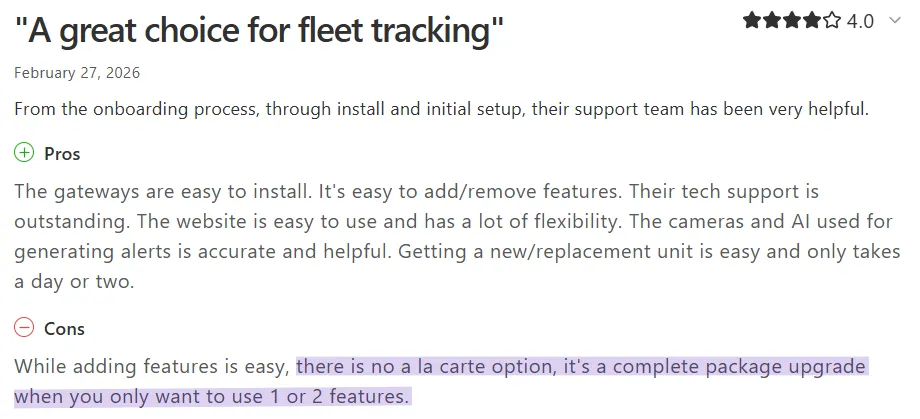
The fleet management software pricing is straightforward too. You pay once for fleet software development, then cover an annual maintenance fee for support, updates, and infrastructure needs. There's no per-vehicle pricing or hidden cost waiting for you when the fleet expands.
So, how much does a custom fleet management system cost? Similar to off-the-shelf tools (but slightly), no vendor will give you a precise number until they understand your project and review your requirements. And we can't either. But after 16+ years in logistics and more than 364 successful projects, including Ecolines, Nova Post, and more, we can share some numbers.
Answer ten questions about your operation. You get a year-by-year comparison of your current SaaS spend against a custom logistics platform built once and owned outright, module by module. Based on Stfalcon's own project-estimation methodology.
Takes about 3 minutes. 17+ years in transportation & logistics stand behind the math.
Before we get to the final cost, our fleet management software development company need to understand what determines fleet management software price.
The price depends, but here's what it depends on
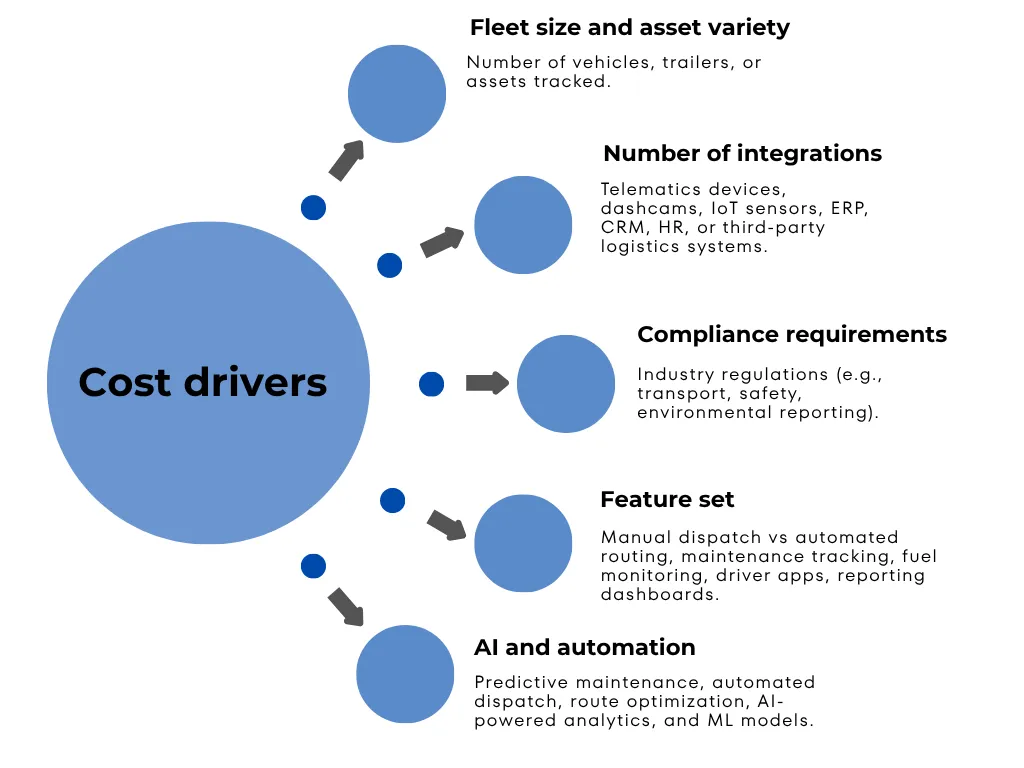
Two companies with the same fleet size can have very different development budgets depending on how their operations run. Below, we'll break down the main factors that drive custom fleet management system cost.
- Fleet size and asset variety
More vehicle types, trailers, and equipment mean a more complex data model and interface. - Number of integrations
Connecting to ERP systems, warehouse management tools, payroll platforms, or third-party telematics hardware adds development scope. Each integration requires its own logic, error handling, and maintenance. - Compliance requirements
ELD mandates, HOS rules, DVIR logs, or IFTA reporting. If your operations span multiple regions or countries, compliance workflows can account for 20-30% of total development effort. - Feature set
A simple tracking dashboard costs far less than a system with automated dispatch, fuel monitoring, maintenance workflows, and driver-facing mobile tools. Every capability you add moves the number. - AI and automation
Predictive maintenance, route optimization, anomaly detection, and demand forecasting require data pipelines and model integration that go beyond standard development.
Read more about Top Logistics Software Development Companies That Understand Logistics, Not Just Code.
How the budget breaks down by phase
Custom software has a reputation for budget mystery, but not at Stfalcon. We believe you should know what you're paying for and why. We break every project into phases, each with its own scope, deliverables, and budget slice.
Phase 1. Discovery & planning (10% of the project cost)
We sit down with your operations manager, dispatchers, and drivers to understand how the fleet runs today. We document every workflow, identify where time and money leak, and define what the software needs to do.
What's covered:
- Requirements gathering
- Workflow and process analysis
- Technical architecture planning
- Feasibility assessment
Phase 2. UI/UX design (15% of the project cost)
We design the product for the people who will use it every day. A dispatcher handling 40 vehicles at 6 a.m. needs a system that feels clear and effortless, so we prototype and validate the interface before moving into development.
What's covered:
- Clickable prototype
- Screen-by-screen user flows
- Mobile and desktop layouts
- Interface testing and iterations
Phase 3. Development & integrations (55% of the project cost)
We start with the features your team needs on day one: vehicle tracking, job assignments, dispatch logic. From there, we build in two-week sprints, so every two weeks you get a working demo to click through and react to. Integrations with your existing GPS hardware, fuel management, or ERP happen in parallel, not as an afterthought.
What's covered:
- Backend and frontend development
- Fleet management features (tracking, dispatch, reporting)
- Driver and manager apps
- Third-party integrations (ERP, CRM, etc.)
- IoT and telematics integrations (GPS, dashcams, sensors)
Phase 4. Testing & deployment (20% of the project cost)
We find and fix issues before your team encounters them. We roll out the launch in phases, so operations stay uninterrupted. We also stay on hand to catch anything unexpected on launch day.
What's covered:
- Functional, performance, and security testing
- System optimization
- Deployment to production
- Documentation
On top of the development budget, you should also account for annual maintenance, which usually comes at around 15-20% of the project cost. This covers bug fixes, security patches, cloud infrastructure management, compliance updates, and more.
Percentages are great for context. Invoices, however, are written in dollars, so let's talk numbers.
Read more about what route optimization software costs, what drives the price, and how it compares to SaaS over three years.
Starting budgets for building fleet management software
Below are three project profiles with realistic starting budgets, based on systems we've built at Stfalcon.
Maintenance-focused platform
Starts at $35,000
Built for companies whose primary pain point is vehicle downtime and unplanned repair costs. Core features cover maintenance scheduling, service history per vehicle, automated reminders based on mileage or time intervals, inspection checklists, and a repair cost tracker. Typically web-based with a lightweight mobile component for mechanics in the field. Integrates with parts suppliers and invoicing tools.
Who it's for: Fleets with in-house maintenance teams who are managing service records in spreadsheets or disconnected tools.
Asset tracking platform with hardware integration
Starts at $60,000
Designed for fleets that need to monitor vehicles, trailers, containers, refrigeration units, or other non-powered assets. The complexity here sits in the hardware layer. You need to integrate with IoT gateways, GPS trackers, temperature and door sensors, and real-time telemetry feeds. The software consolidates all asset data into a unified dashboard with alerting, geofencing, and utilization reporting.
Who it's for: Logistics companies managing mixed fleets where asset visibility is as important as vehicle tracking.
Operations management platform
Starts at $80,000
A broader system covering the full operational layer: client management, order intake, dispatching, driver communication, vehicle assignment, and billing. Includes a web platform for operations managers, a mobile app for drivers, and a client-facing portal for shipment visibility. Integrates with CRM, accounting software, and communication tools.
Who it's for: Growing logistics businesses that have outgrown their SaaS stack and need a single system that connects their team, clients, and vehicles without switching between five different tools.
Agreed, the upfront investment isn't small. But in return, you get a system built for your operations and aligned with the way your business works. The bill doesn't increase with every new asset you add, and you're not tied to a rigid long-term contract. That's where the difference is hard to ignore.
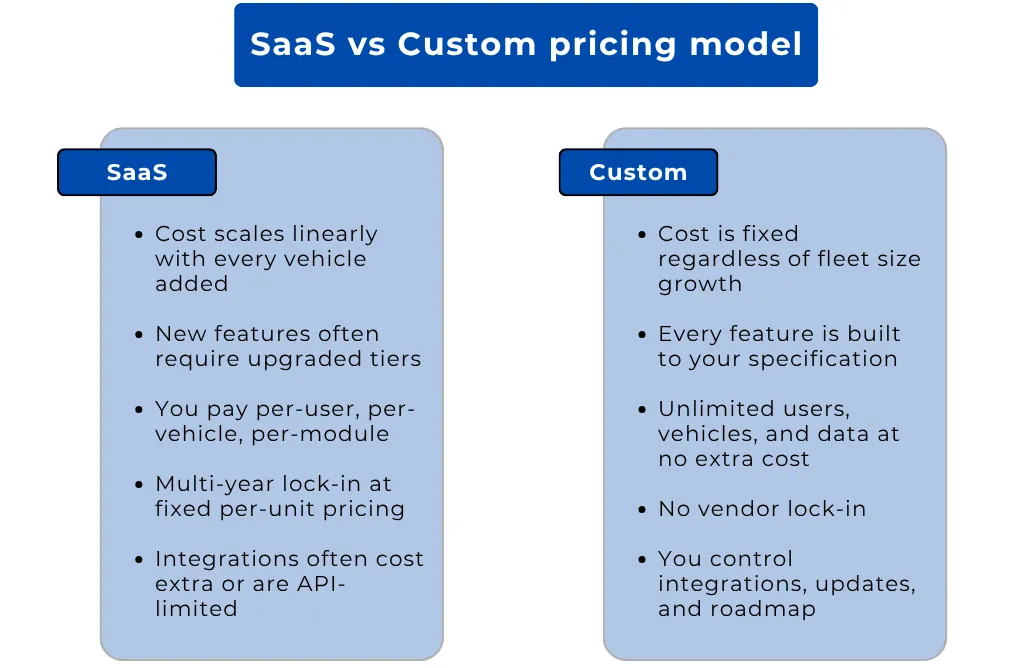
What's more, with the right vendor, you can keep your development costs under control.
How we can optimize your project budget
At Stfalcon, we use pre-built logistics modules for common capabilities such as dispatching, booking, payment flows, dashboards, and other operational building blocks, so we don't have to reinvent standard functionality from scratch.
We speed up delivery with an AI-powered SDLC, using AI for development, testing, debugging, and delivery workflows.
We also rely on our red-yellow-green estimation system to make the budget transparent from the start. In simple terms, we break the project down feature by feature and show you how each one affects the budget and timeline.
- Green features are ready-made, the fastest and most affordable to launch
- Yellow features are partially reusable and adapted to your needs, so they come with a moderate development cost
- Red features are built from the ground up, which makes them the most expensive part of the project
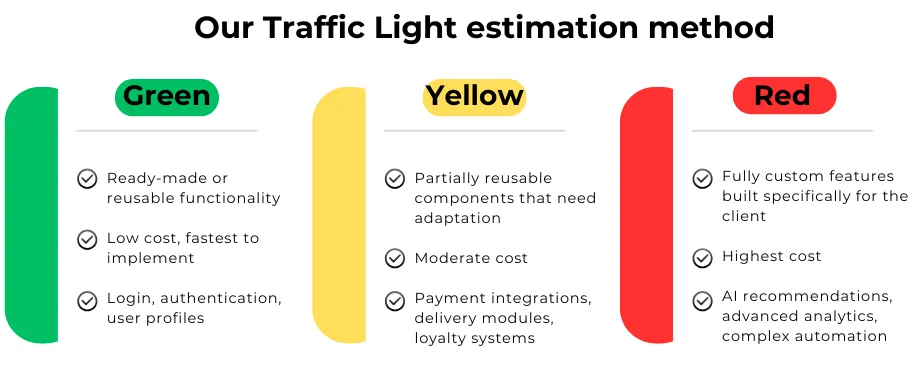
You see where costs can be optimized without sacrificing core functionality. Still, even with that level of transparency and cost control, it's easy to hesitate when a SaaS platform flashes an attractive $27 per vehicle per month. At this moment, you should look beyond the short-term cost and think strategically about how your business will grow over time.
Wrapping up on the average cost of fleet management software. When does custom become worth it?
From our experience and what we know about fleet management software cost in the USA in 2026 and worldwide, companies that move from fragmented SaaS tools to custom fleet management platforms often reduce the total cost to build a fleet management software by 40-60% over five years. This means that investing in custom logistics and transportation software solutions often pays off quickly, especially for large or fast-growing fleets.
Beyond the financial benefits, companies gain greater flexibility, control over processes, and the ability to tailor the platform to their specific needs, making fleet management more efficient and transparent. At Stfalcon, we've spent over 16 years building logistics software for growing operations. If you're looking for a partner who can bring your fleet management project to life, let's start the conversation.