
We’re used to thinking that Uber and Bolt dominate the ride-hailing market everywhere. But when you zoom into regional markets, a different picture appears: local taxi apps overtake global giants when they nail the business model and everyday convenience. In India, the world’s second-largest ride-hailing market, a local taxi app Rapido surpassed Uber and captured nearly half of the market by focusing on bike taxis and a user-first approach.
This isn’t an exception. Across the world, regional taxi apps are winning against Uber and Bolt. What do they all have in common? They don’t try to be the next global app, but focus on a specific niche, city, or use case, and execute it better than anyone else. But how can you build such a product?
We’ll discuss how to choose the right business model for your taxi app, how to structure an MVP, and what scope, timeline, and taxi app development cost you should expect.
These insights are drawn from 16 years of experience in logistics and transportation software. Stfalcon is behind high-load platforms used by millions of people, including solutions for Nova Post , Ecolines, and MeinFernbus. In this guide, we’ve gathered our main advice on building a taxi booking app. So let’s start.
TL;DR
- The winning taxi apps today are not generic Uber clones; they succeed by focusing on a specific niche — a city, customer segment, or a distinct business model.
- Start by defining your business model and operations (who you serve and how you make money), and only then design the product and technology.
- Build an MVP in 3–6 months, focusing on core rider, driver, and operator journeys instead of an overloaded feature set.
- Expect an MVP budget starting from ~$65k, while full-scale multi-city platforms typically begin at ~$150k+, depending on complexity and integrations.
- Working with a partner experienced in high-load mobility or ride-hailing platforms can reduce delivery time by up to ~30%.
Why your business model and niche are your differentiators for online taxi booking app development
Your business model is the foundation of your taxi booking app development. It dictates how you earn revenue, how you acquire and retain drivers, what passengers expect, and what your cab booking software must support.
The most successful regional apps (those that outperform giants like Uber or Bolt) win not because of features alone, but because their taxi booking app has a focused niche and a clear operational strategy.
So before you start building your own solution, you need to define the business model first.
To give you the main options, here are common business models for taxi and ride-hailing apps:
| Main business models for taxi and ride-hailing apps | |||
|---|---|---|---|
| Fleet owner model | Marketplace model | Corporate transport / shuttle | Specialised verticals |
| You own the cars, employ drivers, and control service quality end-to-end. | Drivers bring their own vehicles; you operate the cab booking application (Uber, Bolt). | You have recurring contracts, scheduled rides, and heavy reporting requirements. | EV-only, women-only, pet-friendly, wheelchair-accessible. |
Each model commands different pricing logic, workflows, levels of automation, and complexity in online taxi booking app development. That’s why choosing the right model early is more important than deciding on tech stacks or UI.
Your business model defines the product you should build. Here’s how:
- Revenue logic. Commission-based, subscription-based, corporate billing, or hybrid models determine how the backend of your taxi booking app software calculates fares, driver payouts, invoices, and promotions.
- Supply & demand dynamics. Driver acquisition, incentives, and retention strategies directly affect the complexity of driver app workflows, bonuses, routing logic, and real-time availability.
- Product implications. Corporate taxi apps require strict SLAs and policy-based ride rules; EV fleets need charging-station routing; marketplace taxi apps demand strong identity verification; regulated niches often require specific compliance tools.
Each business model comes with its own set of challenges. We’ve gathered the main ones depending on each model’s specifics:
| Business model | Things to think about in advance |
|---|---|
| Fleet owner |
|
| Marketplace |
|
| Corporate transport / shuttle |
|
| Specialised verticals |
|
Of course, there are more challenges within each business model, but considering the ones mentioned above in advance will give you a solid understanding of which features you actually need to build.
Not sure which model fits your goals?
Share your taxi app concept, and we’ll map the optimal business model
Alina
Client Manager

How to build the architecture for on-demand taxi booking app development
Most people imagine a taxi booking app as two mobile apps — one for riders and one for drivers. But in reality, any taxi platform is a real-time ecosystem.
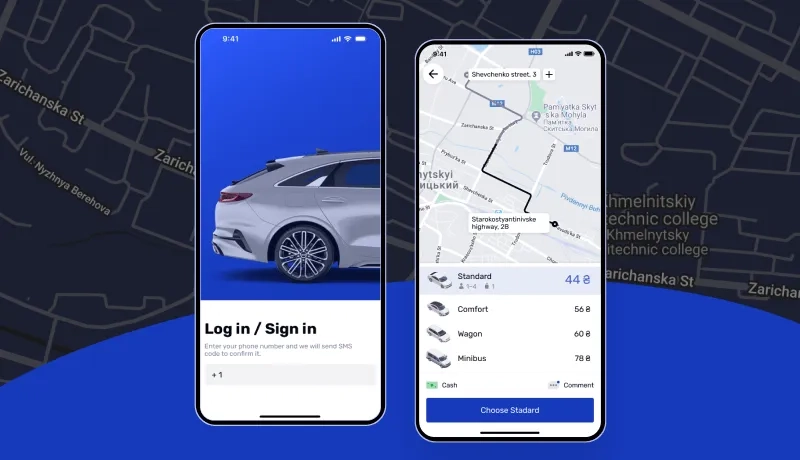
A single ride triggers dozens of backend processes, including pricing, routing, and driver ranking. And each piece has to work flawlessly in seconds. Here’s what on-demand taxi booking app development looks like architecturally, based on Stfalcon’s experience of building BBGO, a ride-hailing system processing 50K+ monthly orders.
 Read the full case study
Rider app
Every ride starts with two questions:
- How fast can I get a car?
- Can I trust this estimate?
This is why the rider app is a conversion engine, not a feature catalog. The key is to reduce every interaction to the fewest possible steps.
Here’s how the ride app works:
| What the rider sees | What’s happening under the hood |
|---|---|
| 1. Pickup → dropoff → ride type → price estimate | Routing service calculates distance, traffic, ETAs, surge multipliers |
| 2. “Driver accepted your order” | Matching engine finds the best driver (not necessarily the closest) |
| 3. Live map + ETA | Real-time GPS update pipeline pushes location every 1–3 seconds |
| 4. “Pay now” or “Pay in cash” | Payment gateway validates method, final fare is recalculated, bonuses applied |
In our BBGO project for a taxi company in Ukraine, the biggest UX win came from instant registration and a streamlined booking flow. Most new users ordered a ride within 30 seconds of installing the app, which significantly accelerated adoption among first-time riders.

Driver app
Driver apps succeed when they remove friction. Every extra tap increases the chance a driver ignores an order — or worse, leaves for a competitor.
Here’s a typical trip lifecycle:
| Driver action | Platform logic |
|---|---|
| 1. Receives offer | Algorithm accounts for idle time, proximity, past cancellations, bonuses |
| 2. Accepts a ride | Driver is locked; estimated arrival is recalculated for the rider |
| 3. Navigates | Routing module optimises path using real-time traffic data |
| 4. Ends trip | Fare recalculation (wait time, stops, bonuses, surge, taxes) |
| 5. Payout | Commission is applied; driver balance is updated instantly |
For BBGO, our custom taxi app development company built a driver app that supports paperless onboarding, automatic search for new orders, and map precision tuned to local driving patterns. This significantly reduced driver idle time and increased completed trips.
Operator or admin portal
A fast-growing taxi business cannot scale through spreadsheets or WhatsApp chats. You need a command center that allows dispatchers, managers, and analysts to control every operational lever.
What admins manage daily:
- Where supply is insufficient
- Where demand is spiking
- Which drivers to approve or block
- How pricing behaves across different zones
- Which promotions increase orders without killing margins
In BBGO, we introduced automatic dynamic pricing — zone-based surge pricing tied to real-time request density. This allowed admins to influence supply-demand balance without manually monitoring every neighborhood. Fares increased automatically within a 5-minute window if more than 10 requests appeared in a single zone.

The outcome: stable operations even during peak hours and severe weather conditions, without human intervention.
Backend & integrations
When a rider taps “Order,” the following chain of events happens within 150–300 milliseconds:
- Booking service creates the request
- Pricing engine calculates base fare, surge, and bonuses
- Matching engine selects eligible drivers
- Notification service alerts both rider and driver
- Routing service recalculates ETAs
- Payment service validates or reserves payment
- Logging service records events for analytics and dispute resolution
To achieve this level of speed and reliability, taxi platforms typically rely on:
- Cloud-native infrastructure (Kubernetes, auto-scaling, CI/CD)
- Map providers adapted to local markets (Google Maps, Mapbox, or regional alternatives)
- Payment gateways supporting multiple customer preferences
- Push and SMS providers that ensure delivery under poor connectivity
In the case of BBGO, we needed to replace a restrictive SaaS platform while maintaining reliability at scale. We built a custom backend that addressed four core challenges typical for taxi apps.
As a result, the BBGO platform now processes 50K+ orders per month.
We can build a taxi app 30% faster thanks to AI
Find out more about our taxi app development services
Alina
Client Manager
Development roadmap and taxi app development timelines
A taxi booking industry app development project follows a roadmap so you don’t burn budget on the wrong features or end up with a fragile system. Here’s what that looks like in practice.
Step 1. Discovery (2–4 weeks)
Discovery is where your idea turns into a concrete plan. By the end of this stage, you should have:
- A clarified taxi app business model (fleet owner, marketplace, corporate, mixed)
- Defined user journeys for taxi passenger app development, driver app, and admin
- A prioritised MVP feature list for your car booking solution
- A rough architecture for your taxi booking app software and integrations
- A realistic budget and timeline for taxi mobile application development
At Stfalcon, this phase starts from ~$5,000 and often saves that amount by preventing scope creep and rework later.
Step 2. UX/UI design (4–8 weeks)
Once you know what to build, you can design it properly for riders, drivers, and operators. Good UX is especially important in taxi apps, as it boosts adoption and reduces support load.
Deliverables usually include:
- Wireframes for core flows in the cab booking application (booking, tracking, payments, support)
- Clickable prototypes of taxi passenger app development, driver, and admin interfaces
- Visual taxi booking app UI design aligned with your brand
Typical design budgets start from $8,000, depending on the complexity of the cab booking software and the number of roles and screens.
Step 3. Engineering (frontend + backend)
This is where your taxi booking app turns into a working platform.
What’s built at this stage:
- Backend services for booking, pricing, routing, payments, and notifications
- API-first architecture so your taxi booking app, driver app, and admin panel can evolve independently
- Mobile apps (often Flutter-based) for taxi booking mobile app development on iOS and Android
- An operator/admin panel to manage drivers, orders, pricing rules, promotions, and reports
This is where most of the taxi app development cost sits, but it’s also where a custom system starts to pay off compared to rigid white-label solutions. The average cost of this stage is around $50,000.
Step 4. QA and pilot launch
A taxi booking app should prove itself on the street.
Before full rollout, it’s best to run:
- Functional and regression testing for all taxi app flows
- Load testing for dispatch and pricing engines
- Field testing of GPS accuracy, routing, and fare calculations in real rides
- A pilot launch in one city or a single segment to validate the full cab booking app ecosystem
Make sure passengers can easily book rides, drivers can accept them within 1–2 taps, and operators can manage operations without constant firefighting.
Step 5. Iterate, scale, and add AI if needed
Once the MVP is live, you can evolve it based on real user feedback.
Typical next steps include:
- Refining dynamic pricing and discount logic inside your cab booking software
- Route optimisation across fleets and zones
- Fraud detection and improved driver/passenger rating logic
- Adding corporate accounts, loyalty programs, and referrals to your taxi booking app
- Using AI and automation to forecast demand, assist dispatchers, or automate routine operator tasks
This is how a basic taxi mobile application evolves into a market leader.
Now, to clarify the costs, here’s the general budget estimation you can expect for taxi mobile app development.
3 main cost tiers of taxi booking mobile app development
Here are typical budget tiers for taxi booking app development:
| Tier | What you get | Typical scope |
|---|---|---|
| Single-region MVP | From $65,000+ |
|
| Multi-city platform | From $120,000–$150,000 |
|
| Enterprise mobility ecosystem | $150,000+ |
|
Here’s one thing that sets Stfalcon’s approach apart: we never push clients to build everything at once. Instead, we use our Traffic Light approach to validate scope early and transparently when providing transportation software development services.
We review your app idea, then flag features as:
- Green: features essential for launch
- Yellow: good to have, but safe to delay
- Red: expensive or risky for MVP
This gives you a realistic roadmap, protects your budget, and ensures your product doesn’t overwhelm users with extra features.
Let’s get to the final question and list the main aspects to consider when choosing the right partner for developing a taxi app.
How to choose a taxi app development partner
Here’s a checklist to evaluate whether a vendor can build a cab booking app that matches your expectations.
Your development partner should have:
- Domain experience in transportation. Taxi platforms behave more like logistics systems than consumer apps. You need a partner who understands dispatching, routing, peak-load behavior, and real-time operations.
- Proven large-scale platforms. Ask for a portfolio. Experience with thousands of daily users, high-load architecture, multi-city support, fleet operations, complex pricing, and real-time geolocation is a major advantage.
- A clear transportation discovery and scoping process. A strong partner won’t jump straight into coding. They will map your business model, define MVP scope, and surface risks early.
- Ability to integrate with your systems. Payment gateways, CRM/ERP, dispatch systems, warehouse software, and compliance tools — integrations can make or break a taxi booking app.
- Post-launch support and iteration. Ride-hailing apps evolve quickly. After launch, you’ll need pricing tweaks, driver incentives, operational automation, and continuous improvement.
At Stfalcon, we don’t stop at launch. Our taxi booking app development company continues to adjust pricing rules, optimise routing, improve driver and passenger flows, and add automation or AI where it delivers real value.
We can add AI-powered features such as:
- AI-driven demand forecasting
- Smart dispatch and route optimisation
- Dynamic pricing based on real-time conditions
- Anomaly detection for fraud or fake GPS activity
Bottom line: even Uber loses to apps with strong value
The taxi booking app that wins in your market is not a generic Uber clone. It’s a focused product built around a clear business model and a specific niche. Technology, UX, and even app architecture only make sense once you know exactly who you serve.
Instead of guessing scope or copying someone else’s feature list, a discovery phase helps you build a product that attracts users from day one.
Stfalcon can help you do exactly that. With more than 16 years of experience in transportation and logistics software, we understand both the technical and operational sides of ride-hailing. We can build a taxi app end-to-end and support you at every stage — from scope definition to architecture decisions.
If you’re serious about launching or rebuilding a taxi booking app that can compete with Uber and Bolt, let’s talk. In a short call, we’ll review your idea and outline a clear scope, timeline, and budget — with no obligations on your side.
Talk with a team that knows transportation inside out
Book a discovery call, no strings attached
Alina
Client Manager
FAQs about taxi booking app development
How long does it take to build a taxi booking app?
A basic car booking solution usually takes 3–6 months for MVP. A more advanced taxi mobile application development project may take 6–12 months.
What are the essential features of a taxi booking app?
Every taxi app should include:
- Rider features (booking, GPS, estimates, payments, ratings)
- Driver features (trip offers, navigation, earnings, onboarding)
- Operator features (dispatch, pricing rules, geofencing, reporting)
- Backend logic (matching, routing, surge, notifications)
For a specific feature list, we use the Traffic Light estimate and divide features into green (must-have), yellow (nice to have), and red (expensive or risky). For such an estimate, book the first call with us, and our experts will help you define the priorities.
How does the matching algorithm work in a taxi app?
In cab booking applications, matching goes beyond the nearest driver. It considers:
- Idle time
- Traffic conditions
- Driver acceptance history
- Rider wait-time promises
- Dynamic pricing zones
At Stfalcon, we build matching algorithms that expand the search radius step-by-step and prioritize drivers who’d been idle the longest to reduce missed orders.
What tech stack is best for taxi booking app development?
Most modern taxi mobile application development uses:
- Flutter for cross-platform rider and driver apps
- Cloud-native backend (Kubernetes, Node.js/Go)
- Google Maps, Mapbox, or local map providers
- Payment APIs like Stripe, Adyen, Braintree, Way4Pay
- Twilio/Nexmo/Sinch for SMS and notifications
But the stack depends on the number of integrations and scaling needs.
How do taxi apps make money?
Common monetisation models include:
- Per-ride commission (marketplace model)
- Subscription fees for drivers
- Surge pricing during peak hours
- Corporate contracts
- Ads or partnerships
Feel free to book a discovery call with us, where we’ll help you choose the right monetization model based on your goals.