The line item you approved (read the WMS subscription) and the actual warehouse management system cost your finance team looks at year-end are two different numbers. For a 65-user operation across five fulfillment sites, that gap reaches $196,666 over 36 months.
Most of the delta hides in what the subscription excludes. Every floor picker carrying a handheld terminal needs a dedicated named license, and those seats stay on the invoice year-round, even during off-peak months. Each storefront and carrier connection adds a standalone API fee. When the vendor pushes a global update, your custom data-sync scripts break and your team absorbs the repair hours.
Over 16 years of building custom WMS, Stfalcon has modeled this math for operations scaling past 100K SKUs (Stock Keeping Units). By month 18, the real WMS system cost runs 40–60% above the original pitch.
Read along to learn how much you actually spend across SaaS WMS tiers, the hidden expenses left out of sales pitches, a three-year financial breakdown, and when building an owned platform delivers greater long-term value than another renewal.
TL;DR
- For a 5-site, 65-user setup, the 3-year TCO is $470,166 on SaaS versus $273,500 for custom software. Switching to custom saves you $196,666 and secures full platform ownership.
- While a SaaS subscription looks cheap ($270 down to $120/user/month), the real budget killers are hidden: per-picker fees, standalone API charges, and billable hours spent fixing broken integrations.
- SaaS works best for a single facility with under 25K SKUs, fewer than 20 users, and simple workflows.
- Custom software becomes necessary once you manage multiple sites, cross 100K SKUs, or waste team hours on manual workarounds.
How much does a warehouse management system cost? SaaS vs custom build at a glance
The entry-point costs for both deployment models look completely different. SaaS requires minimal initial capital but carries compounding recurring fees. Custom development requires a higher upfront investment but flattens your long-term software licensing spend to zero.
Based on independent industry pricing benchmarks, here’s how the standard market entry points break down side-by-side:
| WMS type | Upfront implementation/development | Recurring software fees |
|---|---|---|
| SaaS WMS | $5,000–$50,000+ (One-time onboarding & data migration) | $100–$500/user/month (Plus base platform fees) |
| Custom WMS | $80,000–$300,000+ (Depending on logic complexity, team, & integrations) | $0 / month (100% technology ownership; excludes hosting/infra) |
But the pricing tiers for SaaS hold as long as your operation stays small. To see why a warehouse processing 100K+ SKUs quickly outgrows these basic tiers, we have to look closely at what these upfront fees actually cover, and exactly what they leave out.
WMS cost under the hood or how SaaS vendors package their pricing
WMS providers generally structure their baseline software access through three distinct approaches:
- Per-user licensing is the industry standard for mid-market platforms. For example, Ongoing WMS charges ~ $270 per user / per month, dropping as you add seats, and finally stabilizing at $120 per user/month only once you cross the 20-user threshold. This structure is highly predictable for stable teams but scales linearly with headcount.
- Feature gating model bundle capabilities into standard, advanced, or enterprise tiers. For example, WareGo's basic packages usually cover core receiving and picking, while advanced logic like multi-warehouse routing, advanced batch tracking, or custom API environments sit behind higher-priced corporate tiers.
- Usage-based pricing, tied to orders processed or scans made, can look attractive as an alternative. A 3PL processing 5K orders/day at $0.15/shipping label pays $22,500/month. Peak season doubles that. The economics invert exactly when operations are under the most pressure.
A standard out-of-the-box SaaS package is designed to get a single, standard facility up and running. When you sign a mid-market WMS contract, providers like WareGo and Ongoing WMS offer you:
- Core inventory logic (basic receiving, put-away rules, inventory counting, and guided picking or shipping).
- Basic office access (administrative dashboards and office profiles to monitor basic stock levels).
- Storage mid-size catalogs, and often a built-in cap (WareGo's standard Pro plan, e.g. caps data handling at 25K SKUs).
- Setup framework (initial database creation, data migration, etc.), staff training block, and business-hours helpdesk support.
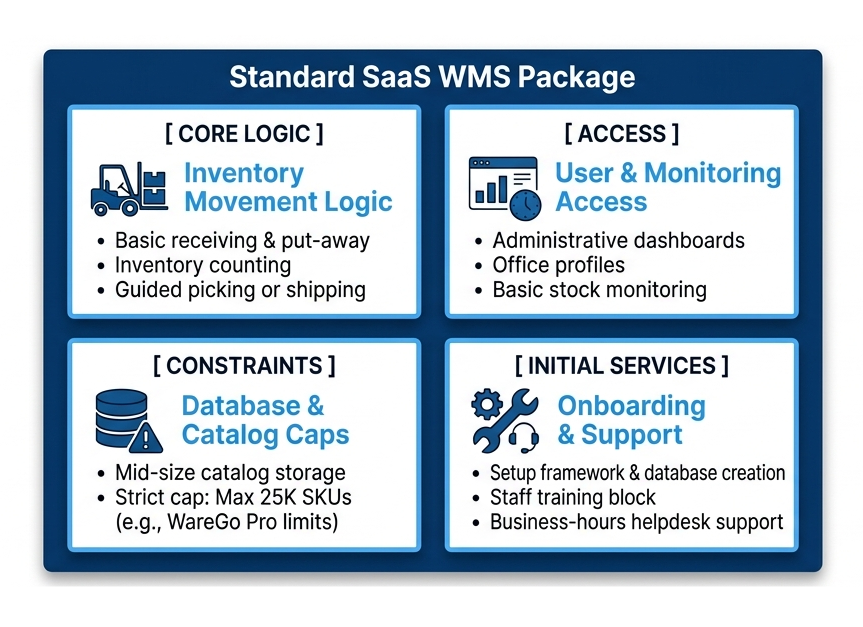
For a single mid-scale facility with a stable team, a single storefront, and a predictable SKU catalog under 25K items, this standard package is more than enough. The math makes sense, the invoices exactly match the sales proposal, and the budget remains highly manageable.
However, this clean, linear financial model only holds true as long as your business stays small. The moment operations trigger real growth, this out-of-the-box pricing structure completely shatters.
Answer ten questions about your operation. You get a year-by-year comparison of your current SaaS spend against a custom logistics platform built once and owned outright, module by module. Based on Stfalcon's own project-estimation methodology.
Takes about 3 minutes. 17+ years in transportation & logistics stand behind the math.
WMS software cost once you scale: where SaaS pricing breaks down
As operations cross specific growth milestones, the visible software subscription becomes the smallest line item on the invoice. When your inventory expands past 100K SKUs, spans 5+ decentralized fulfillment locations, or requires a growing team of 50+ floor staff it completely warps the unit economics of a multi-tenant cloud platform.
This tipping point introduces the SaaS Cost Multiplier. It's how we call the compounding gap between what your subscription invoice says and what your warehouse actually spends to run on that platform.
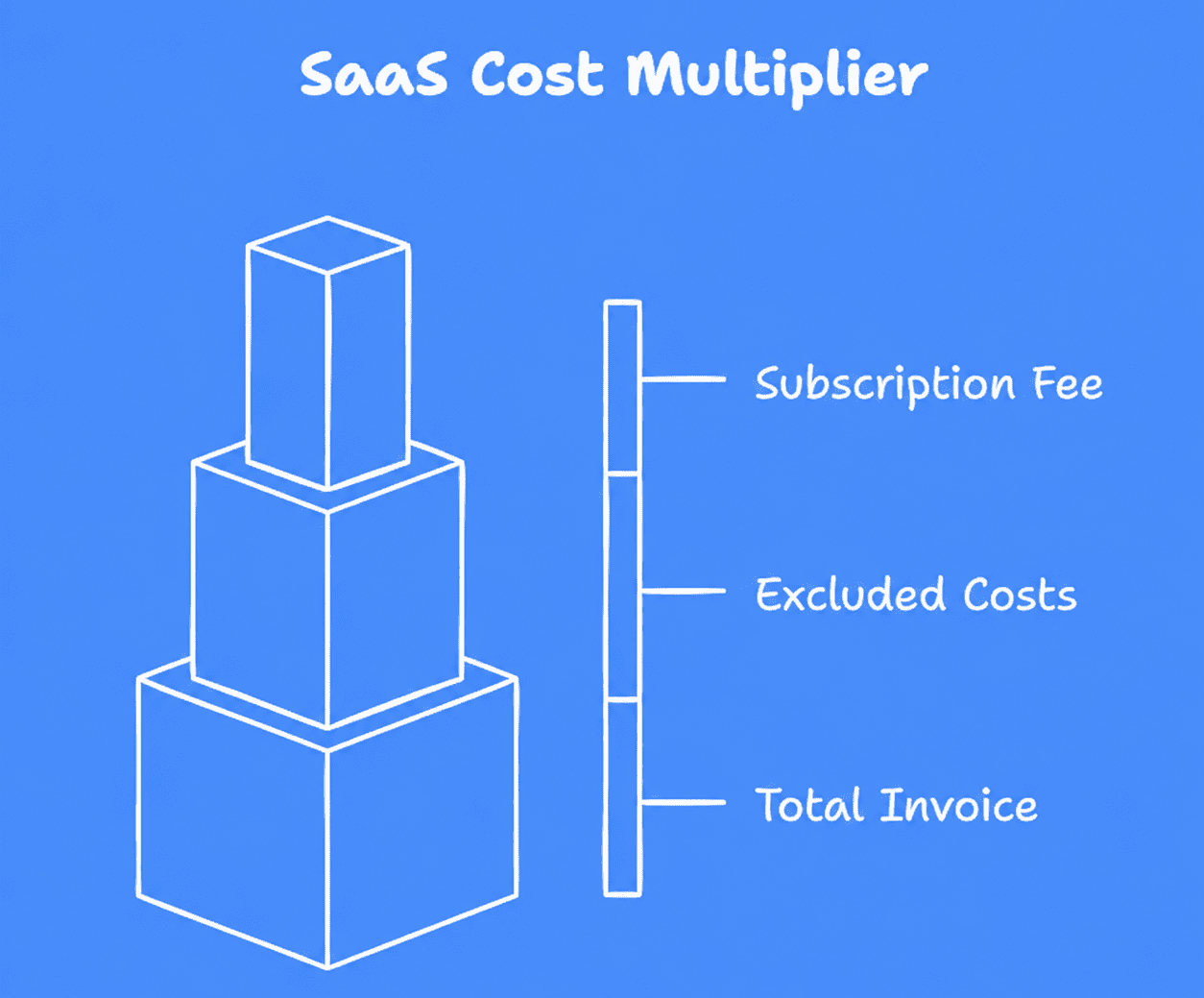
As your volume hits the ceiling, the overhead takes the form of five separate operational drains.
The scaling penalty
Standard tiers charge per named user, and modern multi-tenant platforms strictly prohibit account sharing between shifts. For example, under Ongoing WMS's volume brackets, licenses average around $120 to $255 per user/month. Because each floor worker with a handheld scanning terminal requires their own dedicated, active license, scaling your workforce up for the Q4 peak means your subscription cost spikes drastically. Plus, you continue paying for those dormant user slots all year long during off-peak months.
The spreadsheet tax
Standard cloud software is built for simple, linear warehouse layouts. If you look at WareGo's structure, advanced logistics logic like multi-warehouse routing or multi-site inventory balancing is locked behind their custom Enterprise tier. If you try to stay on a standard package while expanding to 5+ locations, your team has to build side-spreadsheets to manage stock transfers.
The integration tax
Standard SaaS pricing sheet add-ons increase fast. Multi-tenant vendors often charge extra monthly fees for each individual e-commerce platform, marketplace, or shipping carrier integration. If you run multiple storefronts, B2B portals, and an ERP, these standalone connection fees quickly multiply. Furthermore, cloud platforms rarely allow you to access the underlying database directly, forcing you to pay for third-party integration platforms (iPaaS) just to move data.
Every time the SaaS vendor pushes an automatic, global software update, your custom API bridges risk breaking. You have to pay developer hours to continuously test, patch, and maintain connections you don't actually own.
The roadmap delay
When your warehouse requires specialized workflows (like specific kitting or custom sorting rules) that aren't built into the standard platform, you are at the vendor's mercy.
Your feature requests compete with thousands of other users. Under standard SaaS roadmap policies, critical updates can sit in the vendor's backlog for months, stalling your efficiency. If you cannot wait, the vendor will offer to build it for you as an isolated feature at premium developer rates (for example, Ongoing WMS charges ≈ $180/hour). You end up paying to build their product for them.
The exit cost
SaaS ecosystems are built to make leaving expensive and difficult. Your warehouse data and picker efficiency metrics sit in a proprietary cloud database, and exporting them in a usable format is restricted by design.
Also, ripping out an established enterprise SaaS system means rebuilding every single ERP connection and API script from scratch. The downtime cost alone forces many businesses to stay with a vendor even if they’ve outgrown the system long ago.
When these five hidden taxes compound, the financial comparison shifts from a simple monthly operating expense to a long-term strategic decision. To truly evaluate whether to keep paying the SaaS multiplier or switch to a custom solution, you must look at the math over a multi-year horizon.
SaaS vs. custom: a 3-year TCO comparison of warehouse management software price
The per-user fee tells you what you pay this month. However, it doesn't tell you what it costs to run your warehouse on SaaS for three years against owning a custom-built platform.
To map this directly, we can look at a 3-year timeline. Here is how the numbers play out for a logistics operation crossing the enterprise growth milestone: 65 active users split across 5 decentralized fulfillment locations, managing a complex catalog of 120K+ SKUs with standard ERP + TMS integrations:
| Cost category | Year 1 | Year 2 | Year 3 | |||
|---|---|---|---|---|---|---|
| SaaS | Custom | SaaS | Custom | SaaS | Custom | |
| Platform / subscription | $78,600 | $0 | $86,460 | $0 | $95,106 | $0 |
| Build / implementation | $20,000 | $150,000 | $0 | $0 | $0 | $0 |
| ERP + TMS integration | $30,000 | $20,000 | $5,000 | $3,000 | $5,000 | $3,000 |
| Workarounds / extensions | $35,000 | $0 | $50,000 | $15,000 | $65,000 | $15,000 |
| Maintenance / support | Included | $22,500 | Included | $22,500 | Included | $22,500 |
| Annual total | $163,600 | $192,500 | $141,460 | $40,500 | $165,106 | $40,500 |
| Cumulative TCO | $163,600 | $192,500 | $305,060 | $233,000 | $470,166 | $273,500 |
Calculated based on standard mid-market tiers — 65 named users at Ongoing WMS baseline pricing of $110 per user/month.
- SaaS base pricing reflects Ongoing WMS’s international progressive scale. For 65 users, their raw standard tiers (€255/mo for initial seats, dropping to €155, €135, and €110 as volume scales) total approximately €8,250/month. However, for a mid-market contract of this size, vendors typically offer volume contract adjustments. This analysis models a stabilized, blended enterprise rate of $6,550/month ($78,600/year) to ensure a conservative and fair comparison.
- SaaS build/implementation is modeled at a realistic $20,000 upfront vendor fee to map 5 distinct physical locations, configure multi-zone routing, and ingest a heavy 120K+ SKU catalog.
- SaaS price increase includes a standard 10% annual price jump on renewal contracts starting from Year 2.
- The workaround covers the compounding operational friction of forcing a rigid, multi-tenant platform to support a high-volume, multi-site network. This includes seasonal scale charges for mandatory dedicated user licenses for 50+ active floor pickers (enforced via strict anti-account-sharing terms), alongside standalone API connection fees for multiple e-commerce storefronts, and internal developer hours spent building custom data-sync scripts to patch gaps in the vendor's standard inventory allocation logic.
- The $150,000 in Year 1 is a fixed capital investment for a production-ready, tailored WMS engineered from the ground up by a logistics-specialized Eastern European team. Once deployed, user licensing permanently drops to zero. Maintenance and hosting are fixed at 15% of the build cost annually ($22,500).
By Year 2, the custom path is already $72,060 cheaper on a cumulative basis. By Year 3, you get a $196,666 saving in 36 months. And this gap widens every year after, because custom maintenance is flat while SaaS subscriptions keep compounding.
Already outgrown your SaaS platform?
Let's map out your transition strategy and model the 3-year financial plan side-by-side
Alina
Client Manager

Two Stfalcon clients made this switch. Here's what it looked like on the other side.
How BBGO cut platform costs by replacing SaaS with a custom ride-hailing system
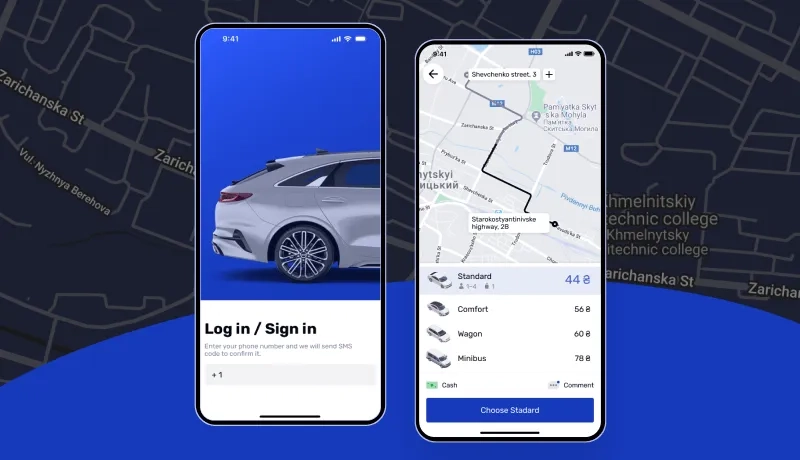
BBGO is a taxi service with over 15 years on the market. As competitors like Bolt gained ground, BBGO's existing platform (TaxiAdmin, a SaaS solution for taxi services) became too expensive and too rigid to support growth.
Stfalcon built a custom ride-hailing platform from scratch: a rider app, a driver app, and an admin panel with dynamic pricing. The team later migrated BBGO's infrastructure from Google Cloud to Hetzner, cutting hosting costs further without service disruption.
 Read the full case study
Compared to SaaS, BBGO’s move to a custom platform let them get lower operational costs, full control over the product roadmap, and a platform handling 50K+ orders per month. While the industry is different, BBGO’s case had the same story when the solution offered by the vendor became a bottleneck, owing to the changes in the final cost.
How Stfalcon built a custom management platform for Nova Post to save $1.3M+ annually
Nova Post runs Ukraine's largest postal network, with 38K employees across 39K service points. At that scale, HR had become a bottleneck. Leave requests, payroll, and document approvals ran through a patchwork of manual tools, and employees had to dig through files just to access a salary statement.
An off-the-shelf HR platform could have replaced the paperwork, but the math at 38K seats made standard SaaS licensing a cost problem of its own. Nova Post also needed deep integration with their 1C ERP system and legally compliant electronic signatures — requirements that sit outside what global SaaS vendors ship by default.
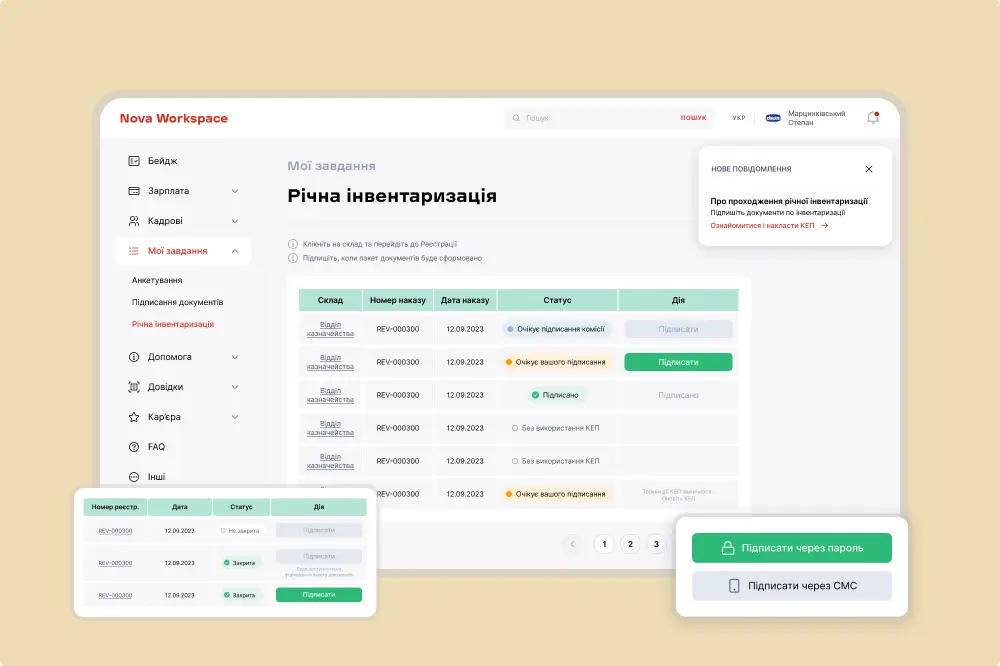
So together, our logistics software development company built Nova Workspace, a custom platform that unified leave management, payroll, e-signatures, and inventory tracking into one system. It now serves 7.5K daily active users and saves Nova Poshta $1.3M+ annually on employee management.
 Read the full case study

What drives custom WMS cost?
The $80K–$300K range in the pricing table above is wide for a reason. Where your build lands depends on how many of these five layers your operation actually needs.
Warehouse logic complexity
Standard pick-and-pack is simple. Costs scale when adding advanced logic like zone-skip routing, multi-tier wave planning, carrier rate arbitrage, dynamic slotting, and cross-docking.
Integration scope
Deep, full-depth sync with ERP, TMS, WCS, carrier APIs, and e-commerce platforms is where logistics-specific expertise produces real cost differences. Connecting a WMS with legacy automation and enterprise systems significantly shapes both the build cost and ongoing maintenance.
Legacy data migration
Moving off paper or older systems requires exhaustive data cleansing, parallel-run testing, and cutover planning to ensure operations don't freeze on go-live day.
Mobile and scanner compatibility
Building a bulletproof mobile client for handheld terminals (TCDs) and RF scanners that works reliably in low-connectivity warehouse environments adds 10 to 16 weeks of development.
Tailored analytics
Moving past SaaS dashboard templates to build custom reporting that tracks real-time labor efficiency, per-zone bottlenecks, and true cost-to-serve metrics.
Hiring a team without specific logistics expertise means paying an indirect "discovery tax". In other words, you fund their hours spent researching domain compliance, pick-routing logic, and carrier integration patterns from scratch.
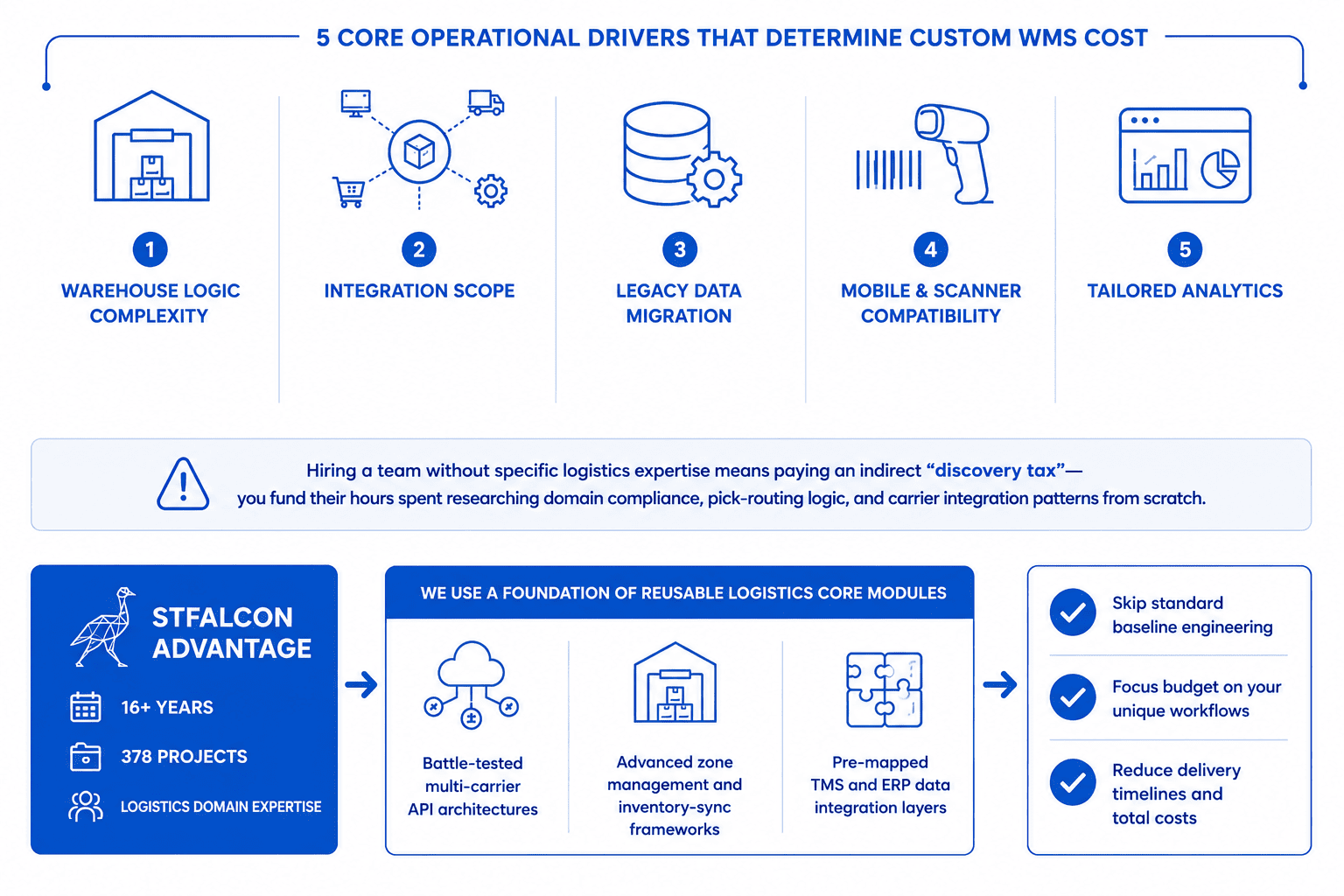
Stfalcon has mapped these architecture patterns across 387+ projects. So instead of starting from zero, we use a foundation of reusable logistics core modules:
- Battle-tested multi-carrier API architectures.
- Advanced zone management and inventory-sync frameworks.
- Pre-mapped TMS and ERP data integration layers.
This allows us to skip standard baseline engineering and focus your budget entirely on customizing the software to your unique warehouse layout and floor workflows, heavily reducing both delivery timelines and total costs.
So SaaS vs. custom, what works for you?
A custom build makes sense at a specific scale, but until then, SaaS earns its subscription. If your operation is still in its early growth phase, a standard platform keeps overhead predictable and gets you running without a six-figure upfront commitment.
A full custom build is likely not cost-justified if your operations fall into these brackets:
- You operate out of 1 or 2 warehouses with linear, straightforward pick-pack workflows that don't require cross-docking or complex wave planning.
- Your inventory catalog sits comfortably below 25K SKUs, meaning a multi-tenant cloud database can handle real-time sync without lagging.
- You have fewer than 20 named users, where standard subscription fees remain highly manageable, and you aren't yet being impacted by steep per-user tier jumps.
Once your team crosses 40–50 active users across multiple facilities, the subscription stops flattening your costs and starts compounding them. Our 3-year model puts that gap at $196,666, and it widens every year after, because custom maintenance stays flat while SaaS renewals keep climbing. At that point, every dollar you spend on licensing buys access to someone else's platform.
A custom build turns that same dollar into an asset you own. So if you’re approaching the enterprise milestone mentioned yet still use SaaS, it’s high time for breaking the renewal cycle instead of comparing warehouse management system prices of other SaaS vendors.
Ready to transition to an owned platform?
Discover how our 16+ years of logistics specialization and ready-to-deploy core modules can help your custom WMS build
Alina
Client Manager
FAQ
What is standard SaaS WMS pricing and how does it scale?
Standard cloud WMS cost usually combines a baseline package fee (averaging $500/month for the first 10 users) with per-seat licensing tiers. At this baseline, the price looks highly manageable. However, as your operation grows and you add named accounts for floor staff, managers, and back-office logisticians, the monthly subscription fees compound.
Why does a custom WMS price yield a better long-term TCO than SaaS?
A SaaS subscription compounds by roughly 10% on annual renewal and penalizes growth at every user-count milestone. A custom platform's overhead freezes after launch into a flat maintenance baseline — typically 15% of the build cost annually. Whether you scale to 50 users or 500, the software cost doesn't move.
How much does a warehouse management system cost to build from scratch?
For a mid-market logistics operation — two facilities, ERP and TMS integration, standard pick/pack/ship workflows — expect around $150,000 for a production-ready, tailored WMS architecture as modeled in our 3-year case study.
What factors dictate custom warehouse management software price?
The main drivers are integration depth with ERP/TMS platforms, the complexity of multi-site inventory logic, data migration from legacy systems, mobile client development for RF hardware, and analytics layer requirements. Team specialization shapes cost as significantly as feature scope — a logistics-specialized team doesn't bill for domain research your platform already required.
How much does a WMS system cost when adding hidden workarounds?
When pricing a SaaS warehouse management system, companies often look only at the base subscription, ignoring the operational "patchwork" required at scale. In our 3-year model, these hidden workarounds add an extra $35,000 to $65,000 annually to the SaaS bill.
What is included in the warehouse management system software price?
A production-ready custom WMS from a logistics-specialized team covers end-to-end delivery: architecture design, database optimization for high SKU density, deployment of reusable core modules, integration layers for ERP and TMS, and custom reporting. Hardware compatibility testing on the warehouse floor is part of acceptance, not a post-launch surprise.
Does a custom warehouse management system software cost include maintenance?
The initial development cost covers build and deployment. Ongoing hosting, cloud infrastructure, and technical support run under a predictable annual maintenance SLA — typically 15% of build price. No unexpected license purchases, no per-user step-ups, no vendor renewal negotiations.