To answer the question right away, logistics software development cost ranges from about $35,000 to $300,000+.
Not very specific, yep. Sorry, we can't give you one exact number. Your project is a black box to us, so the budget depends on scope. And when you look at the price range, custom software does look expensive. But chances are, you already pay for several separate subscriptions to cover what would sit inside that custom system. Then you pay again for the integrations that make those tools talk to each other.
So the question here has two halves. What are you already spending across that stack, and what would it cost to get the same capabilities as your own connected system?
Stfalcon has been in logistics software development since 2009, and we've worked with transportation companies from Nova Post to Ecolines. So let's open that black box. We take it apart module by module and show what makes each one cheap, pricey, or somewhere in between.
TL;DR
- Custom logistics software starts at about $35,000 for a focused system, $80,000 for an integrated platform, and $150,000 for a complex one. Big multi-site builds go past $300,000.
- The price follows your modules (planning, dispatch, fleet, workforce, warehouse, billing, compliance) and how hard each one has to work.
- User roles, integrations, data migration, platforms, reliability, team experience, and AI raise the cost of every module.
- After launch, plan about 15–20% of the build cost a year for support, plus hosting and third-party fees.
- Phased releases, early integration checks, and reusable modules keep the development budget in check.
- SaaS usually wins in Year 1. By Year 3, owning a custom logistics system often costs less than renting several tools and paying to connect them.
How much does it cost to build logistics software these days?
About $35,000 buys you a fleet maintenance system. It runs a single well-defined process with a few user roles. At the high end, $300,000+ covers a complex logistics platform with several connected operations, multiple locations, data migration, and serious load requirements.
| Scenario | Typical scope | Starting budget | Usually excluded |
|---|---|---|---|
| Focused operational system | One process, such as maintenance, order intake, or for one depot, 1–2 integrations, web-first | From $35,000 | Full mobile apps for drivers or clients, data migration, AI, high-load requirements |
| Integrated logistics platform | Several linked processes (orders, dispatch, tracking, billing), scheduled routing, separate interfaces for dispatchers, drivers, and clients, ERP and telematics integrations | From $80,000 | Multi-site rollout, real-time optimization, deep historical migration |
| Enterprise logistics system | Several locations or business units, complex access rights, data migration, real-time operations, scheduled routing, high availability and recovery | From $150,000 | Hardware procurement, third-party licenses, post-launch feature development |
Each starting point covers the first production release. Hosting, support, and third-party fees come later.
If you already think in terms of a WMS, TMS, or fleet platform, we can talk more specific numbers.
| Logistics software | Development cost |
|---|---|
| Fleet management | From $35,000 to $80,000+ |
| Warehouse management (WMS) | $80,000 – $300,000+ |
| GPS tracking | $120,000 – $150,000 |
| Route optimization | $40,000 – $250,000+ |
| Transportation management (TMS) | $200,000 – $300,000 |
| Freight brokerage | $90,000 – $215,000 |
Why a single price misleads
Ask a freight forwarder what shipping costs, and you get a few questions back, like what you are moving, where it’s going, and so on. Software estimates work the same way.
Two platforms can share a feature list word for word. Both have tracking, analytics, and integrations, but one processes 1,000 events a day, and the other processes 1,000 events a second. So when you put them side by side, they might look identical, but their development budgets won't.
What drives logistics software development costs?
Custom logistics software development cost depends on which operational modules you need and how hard each one has to work. Counting screens or features won't get you close, because two similar screens can hide different amounts of logic.
The logistics module stack
We go through the logistics modules in the order work moves, and show what drives the cost of each.
Planning
This module covers demand forecasting, capacity planning, route and load planning, and ETA prediction. Its cost turns on how many constraints the plan has to respect. A route based on only vehicle capacity is one project. A route that also handles time windows, driver hours, service priorities, live traffic, and rebuilds itself when an order changes is a bigger one.
The jump from “build me a route” to “replan it every time an order changes” has a price. Our route optimization software development cost guide shows how that price changes as the constraints pile up.
Order and shipment management
When the plan exists, orders have to become jobs. The system takes orders, creates shipments, builds multi-stop jobs, and sends them to dispatch for assignment. Multi-stop routes add little on their own. Cost climbs when dispatch has to react to changes by itself, for example, reassigning a job when a truck breaks down.
We have a good example from outside freight. BBGO, a taxi service with 15+ years on the market, used to run on a third-party SaaS platform. When competitors like Bolt started to gain ground, the platform became too expensive to support BBGO's growth. So we built a custom platform around its workflows, with apps for riders and drivers, smart dispatch, and dynamic pricing. We also moved the infrastructure from Google Cloud to Hetzner, which cut hosting costs.
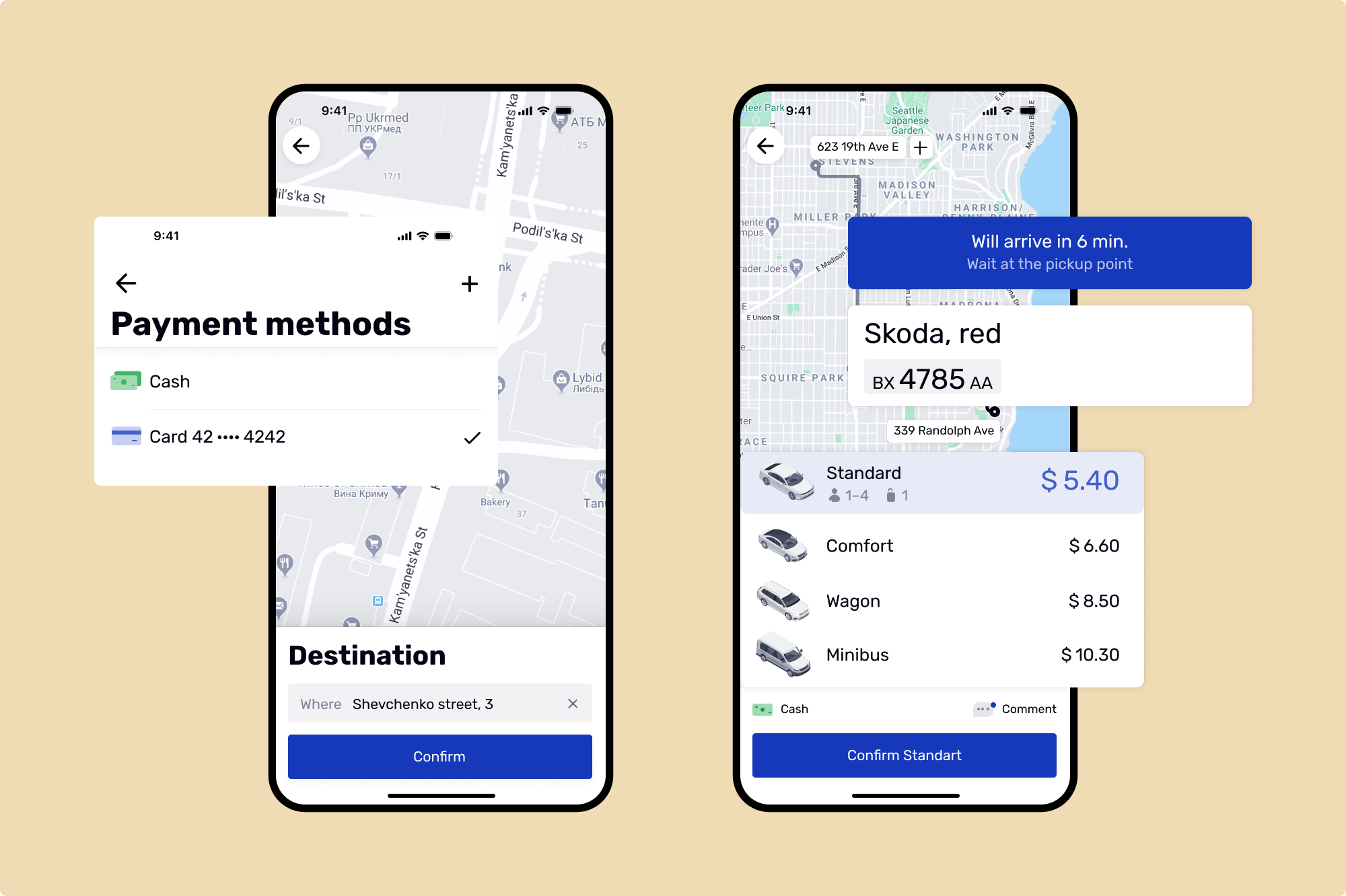
Today, BBGO's dispatch matches riders with nearby drivers across 50K+ orders a month. A taxi ride isn't a shipment, but the assignment logic works much the same way. At that volume, even a small flaw can turn into hundreds of wrong assignments a day.
Fleet and asset management
Behind every job is a truck, van, or trailer that has to stay in working order. Vehicle tracking is the obvious part, but fleet management software goes further into utilization, maintenance, fuel, tires, parts, and the full asset lifecycle.
The build gets more involved when all that data comes from different hardware. Connecting one GPS provider is straightforward. Add five tracker models, reefer units, door and temperature sensors, and ELDs, and now the system has to accept data in different formats from different devices. Then there's volume. A tracker that reports every few seconds from hundreds of vehicles sends a lot of data, and the system has to process it.
All that hardware pushes the estimate higher. See full fleet management software costs, or narrow it down to GPS tracking software.
Workforce management
A workforce system can look simple from the outside. But behind the interface sit scheduling rules, time tracking, payroll, internal communication, driver apps, and performance data.
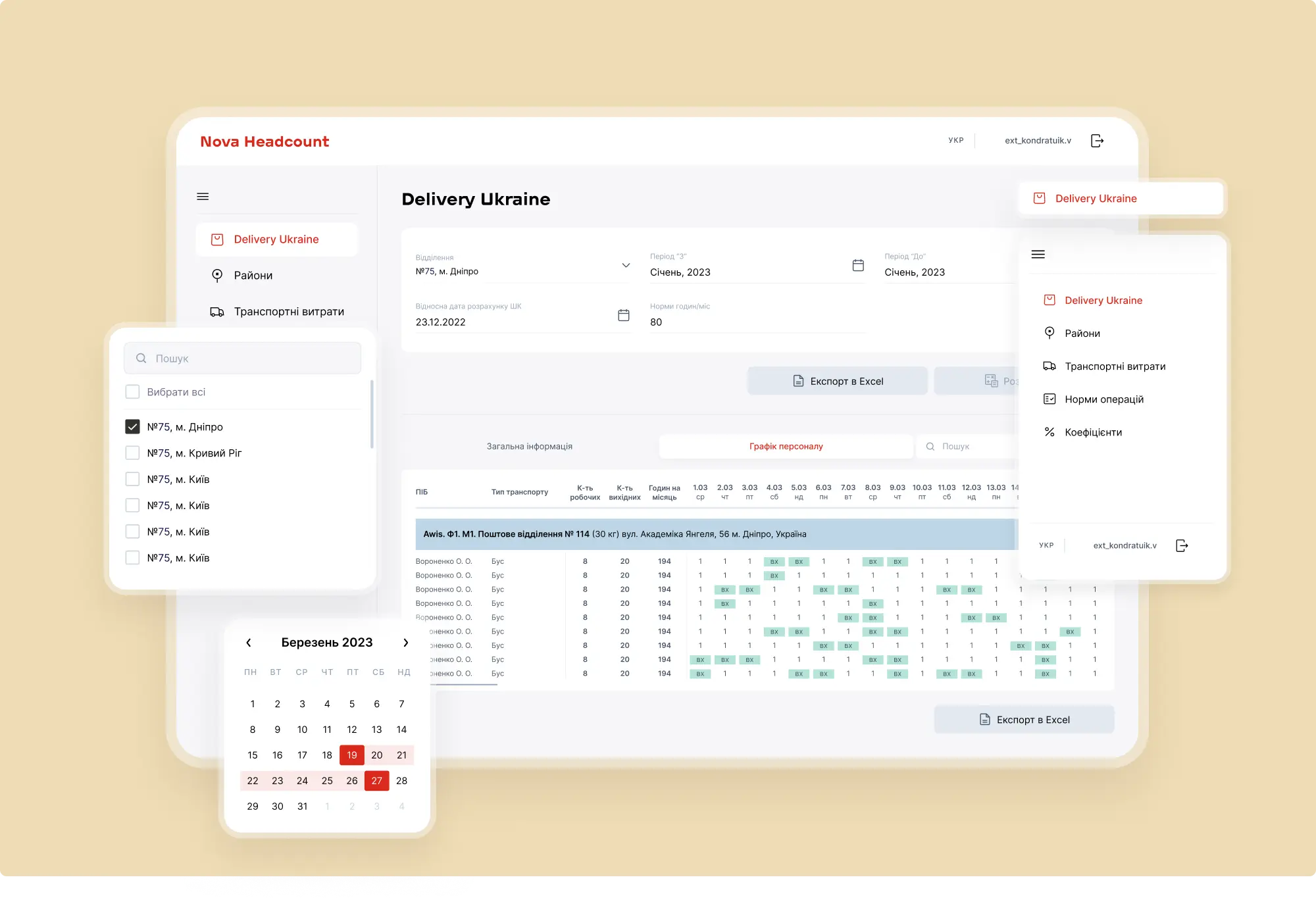
The cost grows when scheduling follows different rules across locations and has to react when demand changes. Nova Post, Ukraine's biggest postal company, deals with both. We helped them build a workforce management system that plans shifts for 38,000 employees in 13,000+ locations and recalculates the schedules whenever local workloads change.
Warehouse and inventory
Between pickup and delivery, goods spend time in a storage facility. Warehouse software must know what arrived, where it was put, what was packed, staged, moved, or returned, and how much stock is available. Workers scan barcodes and RFID tags on the warehouse floor, and stock may change in several locations at once. The system has to collect those updates and keep inventory accurate in real time.
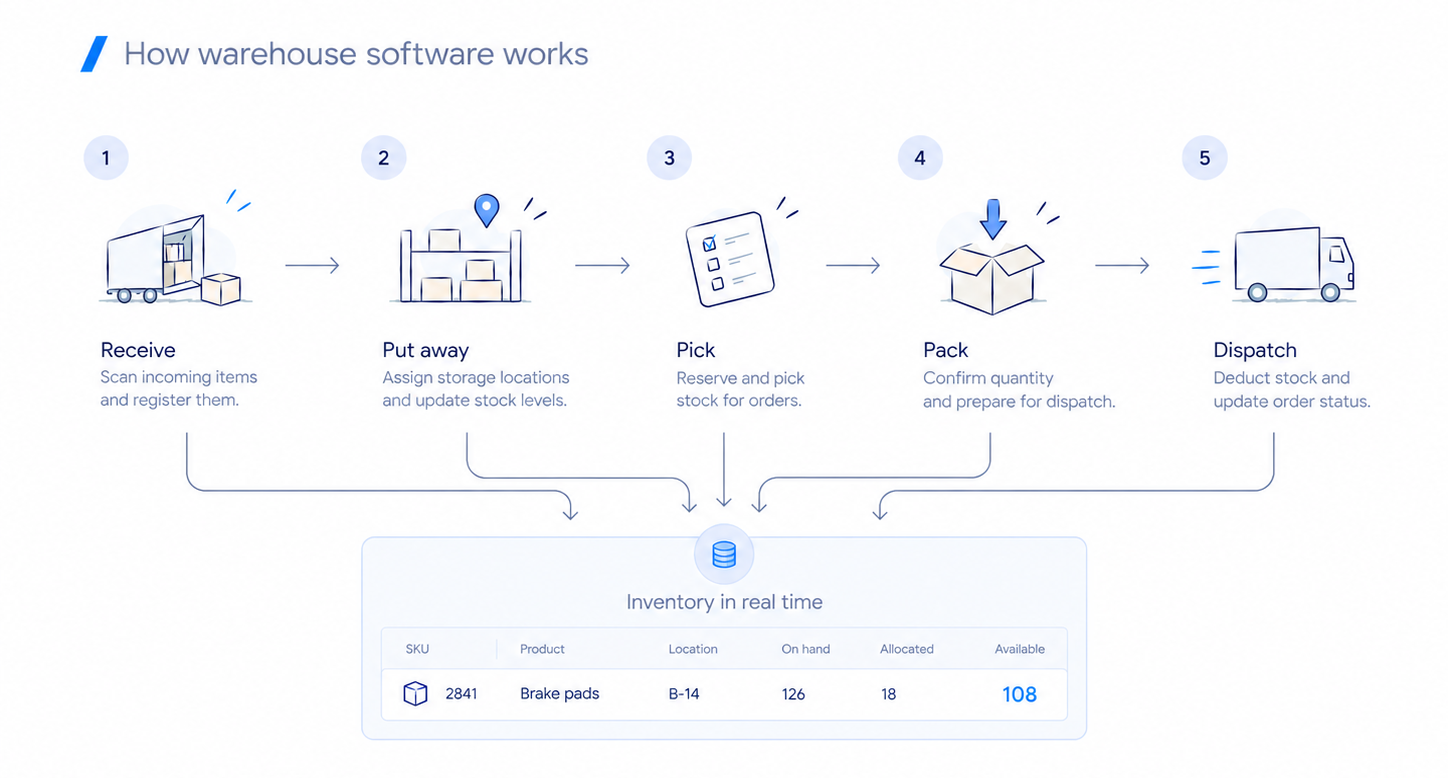
Even the scanners add development work. A mobile client for RF scanners has to keep working in aisles where connectivity is poor, which can add 10 to 16 weeks to the project. Add more warehouses, hardware, and workflows, and the scope grows.
In case you need more details, our breakdown of warehouse management software costs covers the full range.
Financial operations
A flat rate is relatively simple to turn into software. Add contract rates, fuel surcharges, accessorials, tariffs, and customer-specific exceptions, and there are more rules to build. The final charge also has to match what reaches the accounting system. Freight brokerages deal with plenty of this complexity, which is reflected in freight broker software development costs.
Safety and compliance
Here we mean HOS, ELD, customs, local regulations, safety management, and incident reporting. Compliance rules change by country and sometimes by quarter, and the software has to keep up. For operations that span several regions, compliance workflows can take 20–30% of total development effort. So yes, they can take a good chunk of the budget.
If you skipped ahead, we won’t judge. Here’s the whole stack at a glance
| Module | What makes it expensive | What changes the estimate |
|---|---|---|
| Planning | Constraint and optimization logic | Time windows, driver hours, traffic, service priorities, data quality, how often routes re-optimize |
| Order & shipment | Decision logic, real-time state, and exception handling | Automatic reassignment, changing orders, volume |
| Fleet & assets | Hardware and telemetry | Number of device types, data formats, telemetry volume, integration depth |
| Workforce | Scheduling rules | Number of employees, locations, local rules, changing workloads, payroll and mobile integrations |
| Warehouse & inventory | Barcode/RFID hardware and synchronization | Scanners, offline operation, number of warehouses, real-time inventory |
| Financial operations | Rate logic | Contract rates, surcharges, accessorials, tariffs, exceptions, accounting integration |
| Safety & compliance | Regulatory logic | Countries, regulations, reporting requirements, how often rules change |
Now apply the multipliers
You know what makes each module expensive on its own. But that’s not the whole estimate. More roles, integrations, platforms, data, or AI features make any of those modules cost more.
Workflows and user roles
If you have to build for ten office staff in ten different roles, expect more work than for two hundred drivers who share one app. Drivers usually follow the same workflow, so there isn't much variation to handle. Ten roles mean ten sets of permissions, dashboards, and approval rules.
Integrations
If you thought we’d get through a software cost article without the famous “it depends,” here it is. A nightly CSV import from your ERP takes days to build. A two-way ERP sync with validation, conflict resolution, retries, and error alerts requires weeks. The timeline also depends on whether the other system offers decent documentation, a stable API, and a test environment. So it depends. If you want the technical side of it, our guide to logistics API integration explains how to scope this part.
Data migration
Moving data means cleaning it. You need to map reference data such as customers, locations, and rate tables, transfer history, and check that everything arrived intact. Five years of shipment history with three generations of address formats takes extra time, and that time goes into the budget.
Platforms and devices
Each extra platform means more work. A web app, an iOS app, an Android app, and an in-cab tablet each need their own design, development, and testing. Offline mode adds to the bill too. You saw it with the warehouse scanners, and the same goes for driver apps on rural routes, where the signal comes and goes.
Team experience in logistics
Generalist teams bill you for their learning curve. We name it the Price of Figuring It Out as They Go. You pay for their wrong guesses about dispatch logic and the compliance gaps. Stfalcon has built logistics software for 17+ years, so we've seen most of the surprises your project might hold.
AI features, if you need them
When you decide to integrate AI into your project, you pay for the model integration and also for the work around it. That includes preparing the data, checking what the model returns, and handling failed cases. After launch, model usage fees keep coming, usually per document or request, so they belong in your TCO.
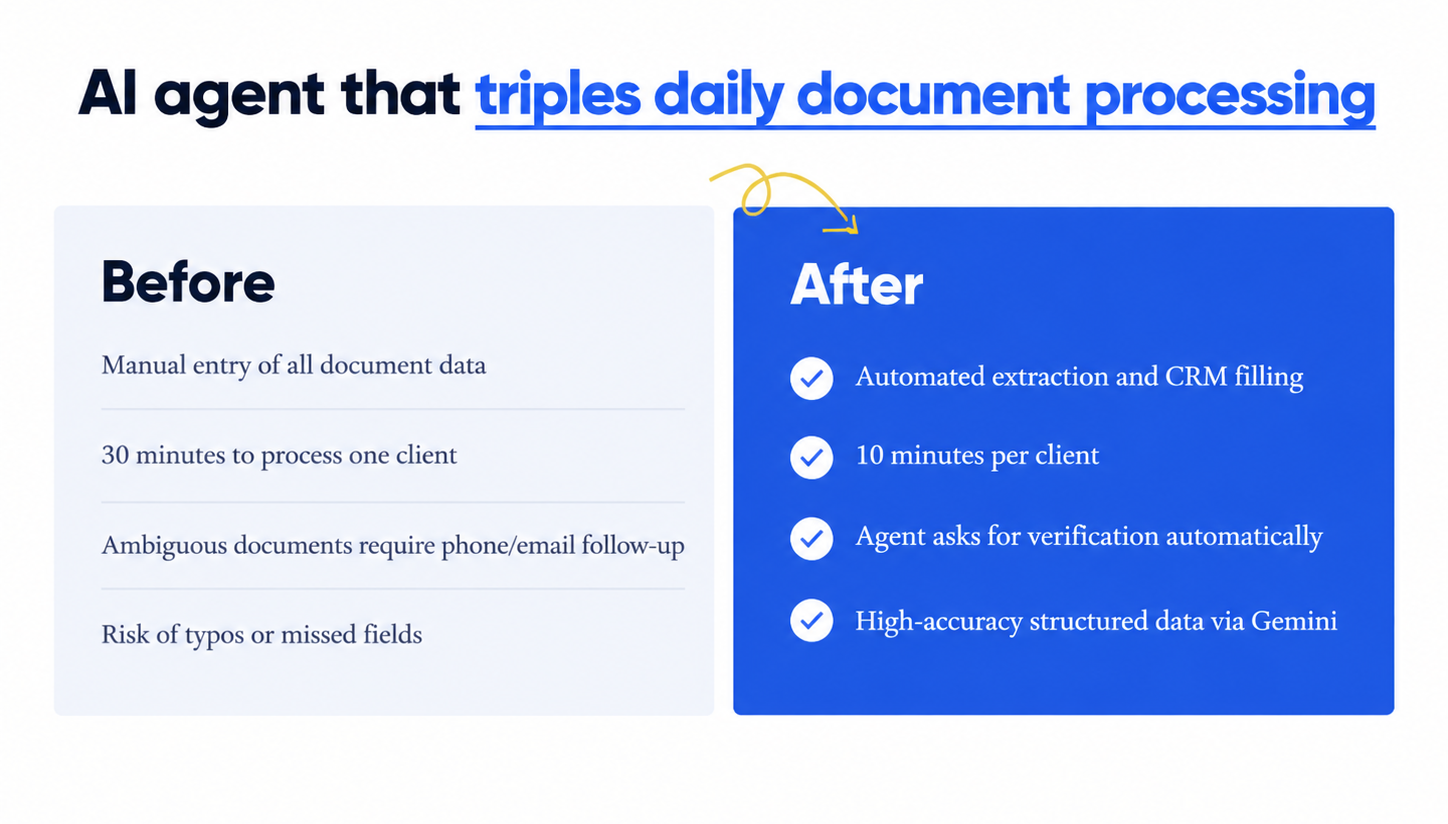
AI pays off fastest when it takes over one manual job. We’ve helped a Ukrainian customs brokerage build an AI agent that reads the vehicle and cargo documents clients send via Telegram and fills in the CRM. Before, managers typed in VIN codes, mileage, and other details by hand, which took up to 30 minutes per client. Now it takes 10, and the team handles three times as many clients a day with the same headcount.
Logistics software cost breakdown: a project example
We’ve looked at the pieces separately. Now let’s see what they cost in one project. Just to be clear, this isn’t one client’s bill. We built the example from our experience in logistics projects.
Let's say it’s a regional carrier with 60 vehicles, 15 office staff, and a growing list of B2B clients. Today it runs on a dispatch SaaS, a telematics subscription, an accounting package, and plenty of spreadsheets.
What goes into the first release:
- Order intake and shipment creation, including multi-stop jobs
- A dispatch board with automatic job assignment and manual override
- Vehicle tracking through two telematics providers
- A driver app for iOS and Android with offline mode and proof of delivery
- Billing and invoicing with contract rates
- Two-way sync with the ERP
- A client portal for shipment tracking
What waits for later: a route optimization engine (the first release connects to an existing routing API), multi-site rollout, warehouse management, and AI features.
What the estimate assumes: one country and one language, up to 2,000 shipments a week, vehicle locations updated every 30 seconds, two years of historical data to move, and an ERP with a documented API and a test environment. If any of these change, the number changes too.
| Work type | What’s included | Cost |
|---|---|---|
| Discovery | Process mapping, requirements, risks, release scope | From $10,000 |
| UX/UI design | Flows and prototypes for dispatchers, drivers, and clients | As a part of discovery |
| Development | Backend, web app for the office, driver mobile app | $92,000 |
| Integrations and migration | ERP sync, two telematics connectors, data transfer | $4,000 |
| QA | Functional, performance, and agreed security testing | $8,000 |
| Launch and training | Environments, phased rollout, team training, handover to support | $6,000 |
| Total for the first release | $120,000 |
What the same project costs over three years
The $120,000 pays for the first release. To see the full cost of owning the system, let's follow the same carrier for three years after launch. Our calculation assumes:
- Support and maintenance cost 15% of the build per year.
- Hosting, databases, backups, monitoring, maps, and SMS cost about $600 a month.
- Connected systems change their APIs a few times a year, which takes about 40 hours of upkeep annually.
- Someone on the carrier's team spends about four hours a week on user accounts, access rights, and questions from dispatchers and drivers.
- In Years 2 and 3, the carrier adds new features, such as automated client notifications and extra reports (the "Planned development" row in the table).
| Cost | Year 1 | Year 2 | Year 3 | 3-year total |
|---|---|---|---|---|
| Initial development | $120,000 | – | – | $120,000 |
| Infrastructure and third-party services | $9,600 | $9,600 | $9,600 | $28,800 |
| Support and maintenance | $18,000 | $18,000 | $18,000 | $54,000 |
| Integration upkeep | $3,000 | $3,000 | $3,000 | $9,000 |
| Administration and user support (your team's time) | $6,000 | $6,000 | $6,000 | $18,000 |
| Planned development | – | $15,000 | $15,000 | $30,000 |
| Total | $154,200 | $49,200 | $49,200 | $259,800 |
Around $250,000 isn’t pocket change, but don’t let the cost of logistics software development scare you right away. Put it next to what you’re already paying, and compare the two with a clear head.
Custom logistics development vs SaaS: How to assess total costs
Custom software looks pricey because you see the whole bill upfront. SaaS splits its bill into many invoices, so each one feels small.
That’s why you need to compare like with like. Put the same functions, usage, and time period on both sides. For SaaS, count subscriptions, premium modules, per-user or per-vehicle fees, integrations, support, and the staff time spent on workarounds. For custom, count development, infrastructure, third-party services, maintenance, and support.
Over three years, the comparison usually follows what we call the Build-to-Own Advantage Model.
Year 1. SaaS wins on speed and upfront cost. Not exactly in our favor, but fair is fair.
Year 2. Costs converge. Subscriptions renew at higher prices, modules and integrations pile up. Custom maintenance stays flat.
Year 3. Custom compounds. You pay a flat running cost for a system that keeps gaining value, and you own it.
Want to see where your own crossover year falls? Enter what you pay for your current stack into the SaaS vs Custom Logistics Software Cost Calculator. It’ll show you when your SaaS stack becomes more expensive than owning the software. And if it doesn’t? It’ll show you that too.
At Stfalcon, we build custom software, but we’re not going to tell you SaaS is always the wrong choice. If you run one or two sites with simple workflows, fewer than 20 users, and stable volumes, a ready-made product will cover your needs for less. Custom starts to pay off when you run several sites, juggle multiple tools, or your workarounds grow. So don’t cross it off the list the moment you see the total cost. The final number isn’t completely out of your hands.
How to control the logistics software development budget
You have more say over the project budget than you think. Here are some ways to keep it reasonable.
Launch in phases
Define a first release that completes one operational scenario end to end, such as order to invoice for one customer segment. A smaller release lowers the first invoice and puts the system in front of real users sooner. Keep in mind that deferring a feature only postpones its cost. But you check what works and plan the next phase from there.
Test integrations before you commit
A short technical check of the ERP, telematics, and carrier APIs shows whether they behave as their documentation promises. The check costs money too, so it belongs in the budget. In return, it removes the most common reason for rework.
Upgrade what you already have
If you own a working legacy system, a full rebuild may cost more than you need to spend. Our approach runs in five phases:
- Audit → Map dependencies and failure points.
- Decouple → Separate fragile logic from the core.
- Replace → Rebuild only what limits scale.
- Extend → Add AI, mobile, and APIs.
- Stabilize → Tune the system for load and maintenance cost.
Before you choose this path, assess which components still hold up and what they'll cost to support.
Reuse ready-made components
Most logistics platforms need some of the same building blocks, so we don't start from zero. Stfalcon has pre-built modules for dispatch, booking, payments, and dashboards. Together with AI-powered workflows, they cut development time by up to 30%.
To show you what that means for your budget, we use the Traffic Light Method. When you know what you want to build, we go through the feature list and mark each item:
Green. We already have it built, so it's fast and cheap to add.
Yellow. It's partly built and needs some custom work.
Red. It has to be built from scratch, so it takes the most time and money.
This way, you see where the budget goes and can decide which red features can wait for a later release. And whether you come to us or another development team, a few extra details will help you get a more precise quote.
What to prepare for a preliminary estimate
A solid estimate starts with a clear picture of your operation. Before you talk to a potential vendor, see how much of this you already have:
- Business problem and current process. What needs fixing, and how does the process work today?
- First-release features. What has to be there at launch, and what can wait?
- Users and operational volume. Roles, number of users, vehicles, shipments, orders, or other useful volumes.
- Platforms and hardware. Web, iOS, Android, tablets, scanners, trackers, or other devices.
- Systems and integrations. ERP, telematics, accounting, carrier systems, APIs, plus any documentation or test access you have.
- Data to migrate. How much history needs to move and any known issues with its quality or format.
- Performance and support requirements. Expected load, update frequency, uptime, security, and support needs.
- Expected growth. More users, vehicles, orders, locations, or regions you already have planned.
- Timeline and budget limits. When you need the first release and how much room you have in the budget.
You don't need every box checked to get a preliminary estimate. Some assumptions might remain around integrations, data quality, and technical complexity. Discovery tests those assumptions and replaces them with real requirements.
Have enough boxes checked? Tell us about your logistics project, and we can start putting numbers around it.
FAQ
What should a logistics software development quote include?
A good logistics management software development cost estimate should show what you’re paying for, meaning discovery, UX/UI, development, integrations, testing, deployment, and project management should be covered. It should also state what isn’t included, for example,hardware, third-party licenses, hosting, data migration, or post-launch support. If you only get one big number with no scope behind it, ask for the breakdown.
How do ERP and carrier integrations affect the budget?
Integrations cause some of the biggest swings in any estimate. A system with a modern, well-documented API can be connected quickly, but an older ERP that only exports files, or that needs direct database access, takes far longer and breaks more often. Each one needs its own connector and ongoing upkeep. An early integration check removes much of that uncertainty.
Can we reduce the initial cost by launching an MVP?
Yes, if the MVP completes one real operational scenario end to end. A smaller first release lowers the first invoice and brings earlier feedback from users. Deferred features still cost money later, so plan the second release in the same budget conversation. An MVP that covers half of dispatch usually creates workarounds and rework.
What ongoing costs should we budget after launch?
Plan for hosting and monitoring, a support agreement for fixes and security updates (typically 15–20% of the build cost per year), third-party APIs such as maps and SMS, AI model usage if relevant, integration upkeep, and user support. New features usually sit outside the support agreement and need their own estimate.
Is upgrading existing logistics software cheaper than rebuilding it?
Often, yes, if the core still works. A code audit shows which parts hold up and which limit scale. Stfalcon runs a paid audit against the real codebase before recommending any rewrite. With our Climb Out of Legacy framework, you replace only what blocks growth and keep operations running during the move. A full rebuild makes sense when the architecture itself holds you back.
How accurate is a cost estimate before discovery?
A pre-discovery estimate gives a realistic range based on similar projects, and it can shift once the team sees your real integrations and data. Discovery narrows it to a feature-by-feature estimate. Treat any fixed number offered before discovery with caution, since nobody has seen what drives most of the cost yet.